
Audit costs climb $45,000 as interim manager seeks outside help; water and trash funds end year $682,000 short
By John Barrella
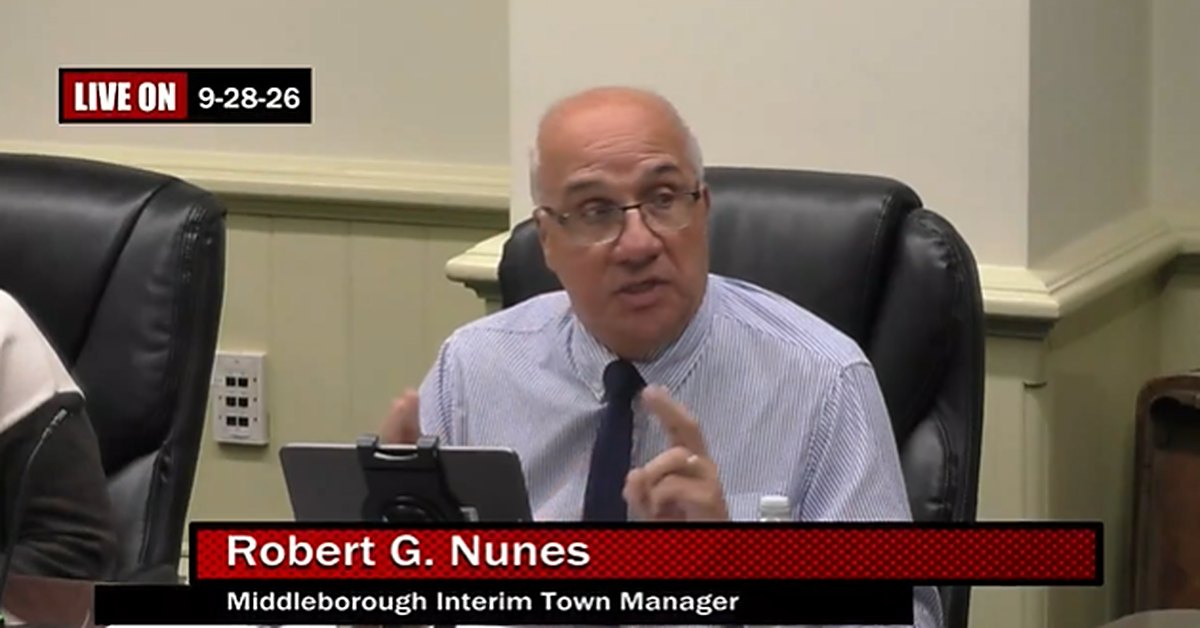
MIDDLEBOROUGH — The firm auditing Middleborough’s finances now wants records going back to fiscal 2021, Interim Town Manager Robert Nunes told the Select Board Monday night. The request came one week after Nunes told town boards the auditors had found material weaknesses in the town’s financial controls.
Nunes said CBIZ, which is auditing the town’s fiscal 2025 books, emailed him Monday asking for the additional information. He has asked Finance Director Sue Nickerson to pull it together and said the auditors are making progress.
At a joint meeting of the Select Board and Finance Committee on Sept. 21, Nunes said CBIZ’s significant findings so far include internal control weaknesses, material weaknesses, and problems with financial reporting, journal entries, debt management, and enterprise fund reporting. That account comes from the meeting’s minutes, which the board approved Monday. He said substantial audit work remains, and that CBIZ will bill the town an additional $45,000 for the added scope and time.
A material weakness is the most serious internal-control finding an auditor can report. It means there is a reasonable possibility that a significant error in the financial statements would not be prevented, or caught and corrected, in time.
Nunes did not say why CBIZ wants records back to fiscal 2021, but findings of that kind could explain it. When auditors cannot rely on an organization’s internal controls, they generally have to test more of the underlying records themselves. Lookbacks of that length are also a common step when an auditor needs a baseline, meaning a point where the books were last known to be correct. From there, auditors can carry the balances forward year by year to find where the numbers began to go wrong. Whether the town’s fiscal 2025 figures are accurate remains an open question, and answering it is the audit’s job.
The problems surfaced publicly in August. In a memo that month, then-interim town manager Joseph Perkins reported that CBIZ had called the audit “significantly challenging” and said it would identify internal control and material weaknesses. He cited the town’s March 2025 switch to new accounting software among the reasons for the delay.
The delay has already had consequences. The audit missed the town’s bond rating call, and the town has since rolled over its short-term borrowing rather than lock in permanent financing. Nunes told the boards Sept. 21 that rating agencies want the audit finished before the next rating call. He said further delay could raise the town’s borrowing costs and push back the fiscal 2026 audit. He recommended hiring an outside consultant to address the findings, saying finance staff are already working at full capacity.
Nunes was Middleborough’s town manager until 2022 and returned this year as interim manager. He inherited a town still working through its finances. In March, Perkins told the Select Board the town faced a potential $3.3 million shortfall. That warning brought cuts across departments and postponed Spring Town Meeting, as well as now Fall Town Meeting.
Nunes also brought new numbers Monday. The town’s water and trash funds closed fiscal 2026 nearly $682,000 in the red, he said. But the money came in as expected. The budget was wrong.
“The good news is that it was not a revenue deficit. It was a budget deficit,” Nunes said. “So we received enough revenue to pay the expenses.”
The water enterprise fund finished $576,041 short, and the sanitation fund finished $105,906 short. Nunes traced both gaps to indirect costs, the charges enterprise funds pay the town’s general fund for shared services such as administration and employee benefits.
“What I think happened was that the indirect cost triggered the budget deficit,” he said.
Monday’s explanation followed questions Nunes raised a week earlier about how those charges are calculated. On Sept. 21, he said the indirect costs charged to the sanitation, wastewater, and water funds needed to be reviewed and recalculated. Those costs cover employee benefits, operating costs, and administrative expenses. He also recommended bringing in an outside consultant to evaluate the long-term charges to the enterprise funds.
Select Board Chair Teresa Farley noted at that meeting that inflated indirect costs had come up earlier in the discussion. Nunes said he suspected that may be the case and that the problem is common in many communities, according to the minutes.
He also told the two boards that, according to Nickerson, the water fund did not end fiscal 2024 or fiscal 2025 in deficit.
Because revenue covered expenses, Nunes said Monday, the shortfalls will not cause trouble with the state Department of Revenue when the town sets its tax rate. He plans to close both gaps with a transfer from the funds’ retained earnings, which needs a Town Meeting vote. The town must also file a plan with the Department of Revenue showing how it will resolve the deficits, Nunes said Sept. 21.
Nunes said the fall Special Town Meeting warrant will carry “at least nine” finance and budget articles. “It could be one or two more,” he said. Earlier in the meeting, the board agreed at his request to move Town Meeting from October to Nov. 9. He cited the volume of work and his ongoing sessions with the finance department.
“I just didn’t want to rush,” he said.
Some of the articles will fix the current budget. On Sept. 21, Nunes said he would begin a detailed review of indirect costs with Nickerson that week. On Monday, he reported that the fiscal 2027 indirect costs for water and wastewater that voters approved at the June Annual Town Meeting were incorrect. They will be adjusted in November. The figures for the Gas and Electric Department and for MCCAM, the town’s community access media station, held up, he said.
“I have now a good handle on indirect cost,” Nunes said.
Another article will close out a deficit the town did not see coming. Nunes said the Department of Revenue has issued a bulletin on COVID-19 deficits. Middleborough carries one of $161,769, tied to pandemic-era funding the town received. He said it appears to stem from the School Department, which may have submitted incorrect information that was then rejected. The state is requiring the town to raise the money this fiscal year.
Nickerson is reconciling the town’s cash. That step must be completed before the town files its balance sheet with the state, which Nunes expects to happen within the next several weeks. He said he is “very confident” retained earnings will come back positive. Free cash, he said, is “most likely to be positive, but it’s not going to be a large number.”
Nunes said he and Nickerson had “a very good meeting” last Thursday.
“We’re getting there as far as working together and putting all the issues together,” he said.
The town’s conversion to MUNIS, the accounting software it adopted in March 2025, remains a work in progress. Nunes said he met last week with IT Director Tara Pirraglia about the conversion, user access, and training. He said the town has no treasurer-collector and no assistant treasurer-collector, which has made the conversion harder and raised concerns about cash flow and collections.
“Let me just say that this is no reflection on the current staff,” Nunes said. “It has been extremely challenging.”
Nunes, the finance team, and Pirraglia were scheduled to meet with MUNIS on Tuesday to work through nine items on an agenda she prepared. An internal meeting with assessors and accounting staff was set to follow. From now on, Nunes said, the internal MUNIS team will meet every two weeks, “just to make sure that we’re meeting all the deadlines.”
At his request, the board held off on posting for interim treasurer-collector services. Nunes said interviews for the permanent job are showing progress and he hopes to bring candidates forward soon.
On trash collection, Nunes said Department of Public Works Director Christopher Peck proposed, and he agreed, that a consultant should study the cost and service impacts of public versus private pickup before any proposal reaches the board.
“Rather than just coming to a meeting and just presenting all kinds of stuff, at least you’ll have something done by a consultant,” Nunes said.
Nunes also met last week with Human Resources Director Hannah Greene and Interim Fire Chief Dana Fontaine about appointing a permanent chief. Greene will contact firms that run assessment centers for public safety candidates, he said.
The board plans to review the Town Meeting warrant at a joint meeting Oct. 5, ahead of an Oct. 15 publication deadline, and to vote its recommendations Oct. 19.
Nunes said he emailed DPW department heads Monday asking them to recheck their fiscal 2027 budgets so this year does not end the way the last one did.
“We still have time,” he said.
Disclosure: John Barrella is an elected member of the Middleborough Finance Committee, which will make recommendations on the Special Town Meeting articles described in this story. He attended the Sept. 21 joint meeting of the Select Board and Finance Committee referenced here. He also serves on the town’s Town Manager Search Committee. This article reflects his own reporting and does not speak for either committee.



Leave a Reply