
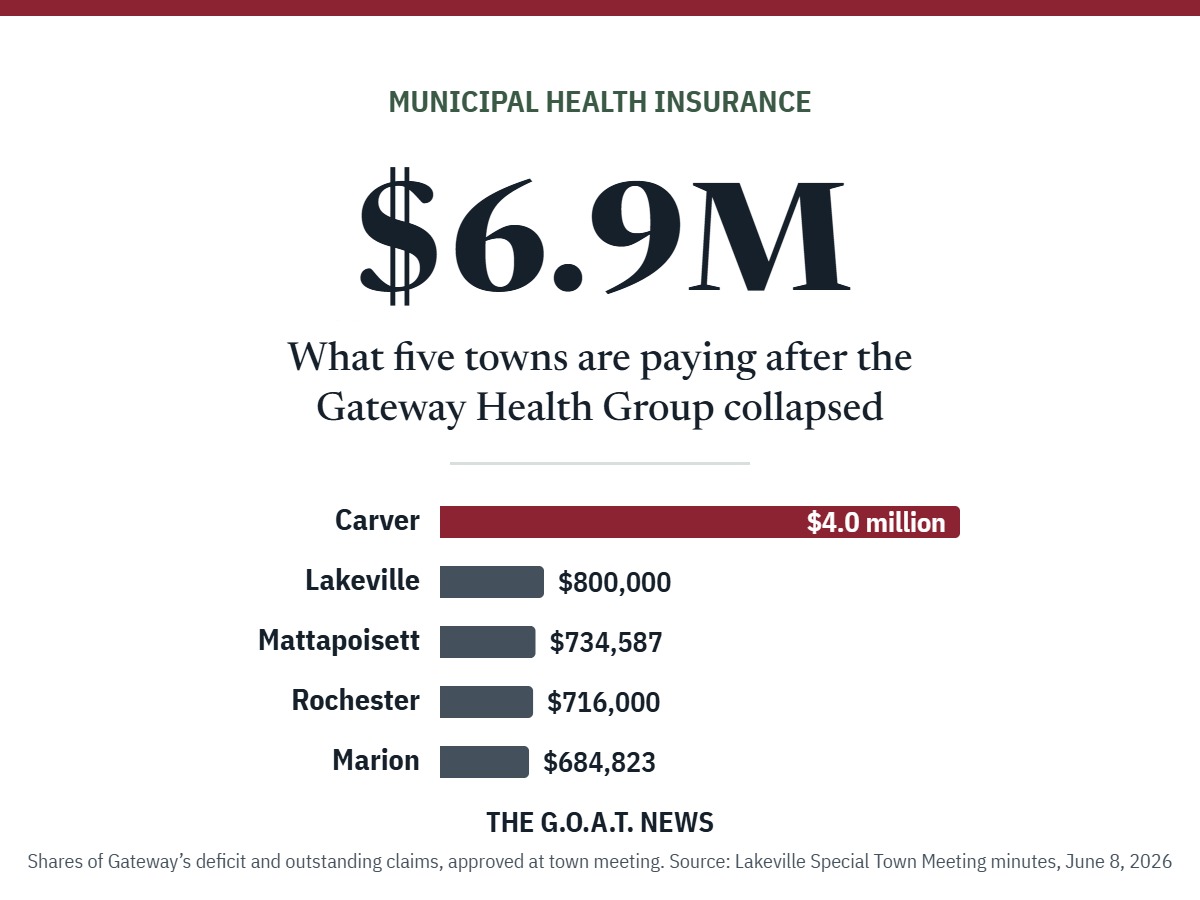
Five southeastern Massachusetts towns are paying more than $6.9 million after a small municipal insurance pool collapsed. State law does little to stop the next one
By John Barrella
EDITORIAL – In April, Carver’s Town Meeting voted to spend $4 million it had never planned to spend. The money did not buy a fire truck or fix a school roof. It paid medical bills the town’s health plan could not cover.
Carver belonged to the Gateway Health Group, a small, self-funded insurance pool it shared with Lakeville and the Old Rochester Regional School District. Members of a pool like Gateway do not buy a policy from an insurer. They pay their employees’ claims from a shared trust. According to Lakeville’s Special Town Meeting minutes, Gateway’s board approved a rate increase in early 2025 on its broker’s recommendation, and actual claims came in “significantly higher” than projected. The board then voted to dissolve the group, ending benefits on June 30, and every member got a bill.
Carver’s share was $4 million, drawn from free cash, a solar revenue fund and next year’s tax levy. Lakeville voters approved $800,000 in June. Marion, Mattapoisett and Rochester, which fund the Old Rochester district, approved about $2.1 million among them, according to the same Lakeville minutes. That comes to more than $6.9 million.
Taxpayers may not be the only ones paying. Carver’s warrant article noted that under the town’s union contracts, employees pay 25 percent of the cost of their health insurance. The town said it would work with Gateway and its employees “to address the issue of recovering their share of liability” once the total was known.
The warning signs were on paper. A January report to the Old Rochester School Committee showed that Gateway’s trust was already $1.1 million in the hole on June 30, 2025, and projected a $4.6 million deficit a year later. Claims had risen 23 percent in 12 months, to $13.1 million. More than $1 million went to GLP-1 drugs, the class that includes Ozempic and Wegovy.
Gateway’s members are not alone. The Hampshire County Group Insurance Trust, which serves more than 12,000 active and retired municipal employees and their dependents, reported spending about $4.5 million on GLP-1 weight-loss drugs from January to September 2025. It followed an 18 to 20 percent rate renewal with a 20 percent midyear increase. In March, the state’s Group Insurance Commission reported that 11 municipalities would join it on July 1.
State law does almost nothing to prevent this. Chapter 32B, Section 12 of the General Laws lets two or more towns pool their health coverage and requires them to agree on how to split the claims. It sets no reserve standard for the pool. It requires no independent review of the rates a pool’s board adopts. Section 3A requires each town to audit its own claims fund once a year, which tells officials what went wrong after the money is gone. And it is blunt about who covers a shortfall: a claims fund deficit “shall be raised in the next fiscal year’s tax rate.”
The Legislature should fix this before the next pool fails. Joint purchase groups should have to hold a minimum reserve. An independent actuary should certify their rates, so the number does not rest on a broker’s recommendation alone. They should file quarterly claims and reserve reports with the state Division of Local Services and with every member’s finance committee. And small groups should have a clear, affordable route into the GIC or a larger pool before they run dry, not after.
Local officials have work to do as well. Health insurance is among the largest costs a town carries. Carver’s fiscal 2027 budget set aside about $6.6 million for it before voters added $1.5 million more for Gateway. In a self-funded plan, that risk sits with the town. Finance committees, including the one I serve on in Middleborough, should insist on seeing claims reports at least quarterly. They should ask the question Gateway’s members answered too late: what happens if claims run 20 percent over the rate?
In January, the Old Rochester School Committee took up a proposal to hire outside counsel to examine how the trust was run and what its broker did. A legal fight may recover some of the money. It will not refill the free cash and reserves five towns have already spent. A law that catches the next Gateway before its members get the bill would.
John Barrella owns and operates The G.O.A.T. News, which covers Middleborough and surrounding towns, and serves on Middleborough’s elected Finance Committee and appointed Town Manager Search Committee.

Leave a Reply