
Carver · Investigation
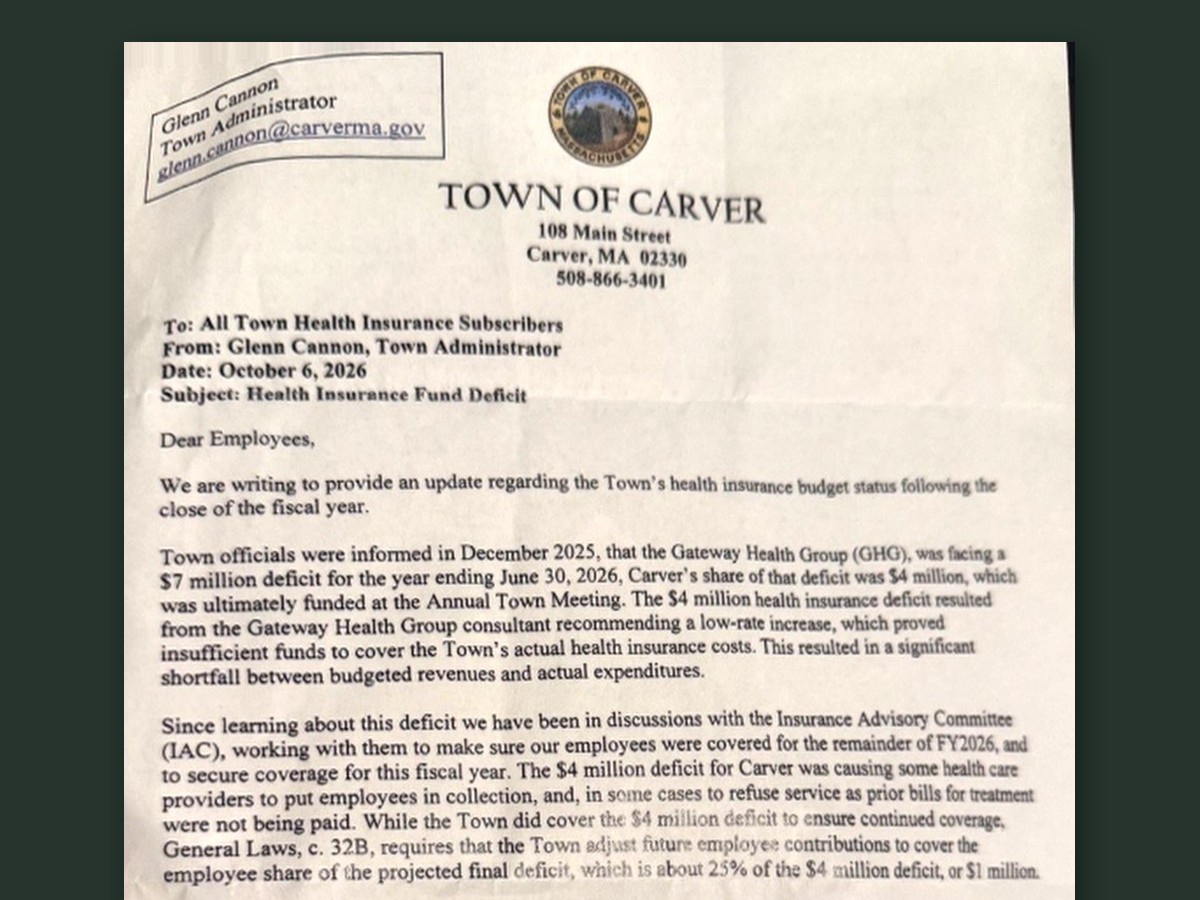
Unpaid claims in Carver’s failed health insurance pool led some providers to send town employees to collections or turn them away, the town administrator told workers in a letter obtained by The G.O.A.T. News. The same letter says employees’ share of the $4 million deficit is about $1 million. No decision has been made on how to collect it.

CARVER — Unpaid bills in Carver’s failed employee health plan led some medical providers to send town workers to collections and, in some cases, to refuse them care, Town Administrator Glenn Cannon told employees this month. In the same letter, he told them state law requires the town to adjust their future contributions to cover their share of the plan’s deficit, which he put at about $1 million.
The Oct. 6 letter, addressed to “All Town Health Insurance Subscribers” and obtained by The G.O.A.T. News, says no decision has been made on how to collect that money. One option under consideration, Cannon wrote, is “having employees make a retroactive contribution toward the employee portion of the deficit.” If that approach is approved, the letter says, the town “would consider implementing the employee contribution incrementally to help minimize the impact on employees.”
The letter goes further than anything in the Select Board’s posted minutes reviewed by The G.O.A.T. News about what the collapse of the Gateway Health Group meant for the people it covered. Its figures, from a December warning to the $1 million employee share, match the town’s public records.
Carver spent about two years in Gateway, a small self-funded pool it shared with Lakeville and the Old Rochester Regional School District, before the pool dissolved June 30. Town Meeting voted $4 million in April to cover Carver’s share of the losses, as The G.O.A.T. News reported Oct. 1. This account is drawn from the letter, the Select Board’s minutes, the April 7 Town Meeting minutes, state law and records of the other Gateway members. Minutes of the board’s Oct. 6 meeting, where health insurance was on the agenda, have not been posted.
What the letter tells employees
Town officials were told in December 2025 that Gateway faced a $7 million deficit for the year ending June 30, 2026, and that Carver’s share was $4 million, the letter says. It says the deficit “resulted from the Gateway Health Group consultant recommending a low-rate increase,” which did not bring in enough money to cover what the town’s health insurance actually cost. In March, Select Board Chair Mark Townsend identified Gateway’s consultant as NFP and said, “It is clear that NFP has completely failed” to provide competent guidance, according to the March 17 minutes.
Then the letter turns to what employees went through:
“The $4 million deficit for Carver was causing some health care providers to put employees in collection, and, in some cases to refuse service as prior bills for treatment were not being paid.”
The letter does not say how many employees were affected, when it happened or whether those bills have since been paid.
In public, the town said less at the time. At the board’s March 17 meeting, member Dan Ryan asked whether employees’ health care would be disrupted. “Mr. Cannon stated that health care is being impacted currently,” the minutes record. They do not say how.
The town covered the full $4 million “to ensure continued coverage,” the letter says. It goes on: “General Laws, c. 32B, requires that the Town adjust future employee contributions to cover the employee share of the projected final deficit, which is about 25% of the $4 million deficit, or $1 million.”
Retirees on Medicare plans are not affected. Those plans “were fully insured and were not part of the deficit,” the letter says.
The letter also acknowledges “the substantial increase in cost of coverage this year.” When the board approved rates in April for the town’s new insurer, the Massachusetts Interlocal Insurance Association, known as MIIA, the HMO plan went up 27 percent and family PPO coverage went up 30 percent, the April 10 minutes show. Member Sarah Hewins said the town’s other choice “would have been a 50% increase.” Moving to MIIA put the town in “a fully insured plan, meaning that our cost for coverage this year cannot increase beyond what we are paying,” Cannon wrote.
The letter tells employees to contact their representative on the town’s Insurance Advisory Committee for updates. On April 10, when member Jim Hoffman asked whether the committee had been told all of it, Cannon said it had discussed a percentage increase “but not the other options or in depth like this,” the minutes show.

The law the letter cites
The letter does not name a section of Chapter 32B. The one that governs self-funded plans is Section 3A, and Section 12 applies its requirements to any town or district that joins a pool like Gateway.
Section 3A says that when claims payments leave a town and its employees sharing costs in a ratio different from the one the law sets, “the subdivision shall adjust future contributions toward the total monthly premium or rate to compensate for the inconsistency.” It also says the amount of any deficit in a claims trust fund, “if not otherwise provided for, shall be raised in the next fiscal year’s tax rate.”
Carver covered the deficit in April. Voters put $1,510,295 on the fiscal 2027 tax levy, 118 to 30, and took $1,465,785 from free cash and $1,023,920 from the surplus in the town’s solar net metering fund, 120 to 17, according to the Town Meeting minutes.
The letter uses two different terms for what comes next. It says the law requires the town to “adjust future employee contributions.” It then describes the option under review as a “retroactive contribution.” It does not say whether that would mean a larger employee share of premiums going forward, a separate payroll deduction or some other method. The posted records do not show any opinion from town counsel on the question.
Any change also has to go through the unions. On April 21, the minutes reported that the town’s Public Employee Committee had held “some discussion but no real negotiations regarding the 25% that would be due from the employee as the portion of the Four-Million-dollar insurance shortage.” The board voted 5-0 that night to start the process for changing health benefits under Sections 21 through 23 of Chapter 32B, which runs through that committee.
Seven months without a public plan
Cannon’s letter comes almost seven months after a board member first asked in public how the town would get the employees’ share back. On March 17, member John Cotter asked, in the words of the minutes, “what is the plan to recoup that 25% which equates to 1 million dollars.” Cannon “stated there is not a plan at this time.”
On Aug. 4, the minutes gave Cannon’s health care update two sentences. “Update on the Health Care issue, still in negotiations with the unions in town. There is a mitigation fund of around 2M and looking to gather more info on this in September,” the minutes read. They do not say what the mitigation fund is, where its money came from or whether it could reduce what employees owe. Cotter suggested taking up the issue in executive session.
On Sept. 22, the board went behind closed doors to discuss strategy for collective bargaining over “health insurance, all municipal unions,” the minutes show. The public record does not show what was discussed.
The board’s Oct. 6 agenda listed a 6:50 p.m. “Discussion on FY 2027 health insurance deficit.” Cannon’s letter, dated the same day, concerns the deficit for fiscal 2026, the year that ended June 30. On its second page, it says the town will keep working with the advisory committee “to address the issue of the FY2026 deficit.” Until minutes are posted, the record does not show whether the agenda’s wording was a mistake or whether a second deficit is building this year. The G.O.A.T. News described that agenda item on Oct. 12 as a shortfall in the budget year that began July 1, following the agenda’s wording. The letter indicates the discussion that night may have concerned last year’s deficit.
What taxpayers have paid

More than a third of Carver’s $4 million landed on this year’s tax bills. The rest came from free cash and the solar fund surplus. On March 10, Cannon told the board the projected deficit was going to be $4 million “and this is a crisis,” according to the minutes, and the board voted 4-1 to deviate from its financial policies to tap the stabilization fund. That plan later switched to the solar fund surplus. At a June 2 joint meeting with the Finance Committee, the minutes record that “Capital was cut to be used for Health Insurance, debt was authorized.”
Legal bills have grown along with the crisis. By June 22, legal spending had reached $178,000 against a $140,000 budget, Finance Director Karen Preval told the Finance Committee. The committee moved $80,000 from its reserve fund into the legal budget, and its minutes name “ongoing lawsuits against the Gateway Health Group and personnel issues” as the reasons. The Select Board’s July 7 minutes say the transfer “is due to the Gateway Health group issues.”
If employees do repay their share, neither the letter nor the posted minutes say where that money would go, whether back to the accounts taxpayers drew on, into this year’s health insurance budget or somewhere else.
The town may also try to recover money from NFP. Townsend said in March that the town was considering “possible litigation against NFP.” Gateway’s wind-down board, which Cannon chairs, scheduled a closed session on litigation with NFP for Oct. 8, its agenda shows. Nothing in the public record says whether employees would share in any recovery.
Who was watching the pool
The letter dates the town’s knowledge to December 2025. Records from another Gateway member show the pool was in trouble earlier. A report prepared for the Old Rochester Regional School Committee in January showed the trust was already $1.1 million short on June 30, 2025, months before that December warning.
The records reviewed do not show who represented Carver on Gateway’s board in 2025 or what financial reports that board received. Gateway’s agendas this year list Cannon as chairperson, and they do not show when he took that role. Carver’s online Agenda Center posts two Gateway agendas, for Sept. 10 and Oct. 8, and no Gateway minutes.
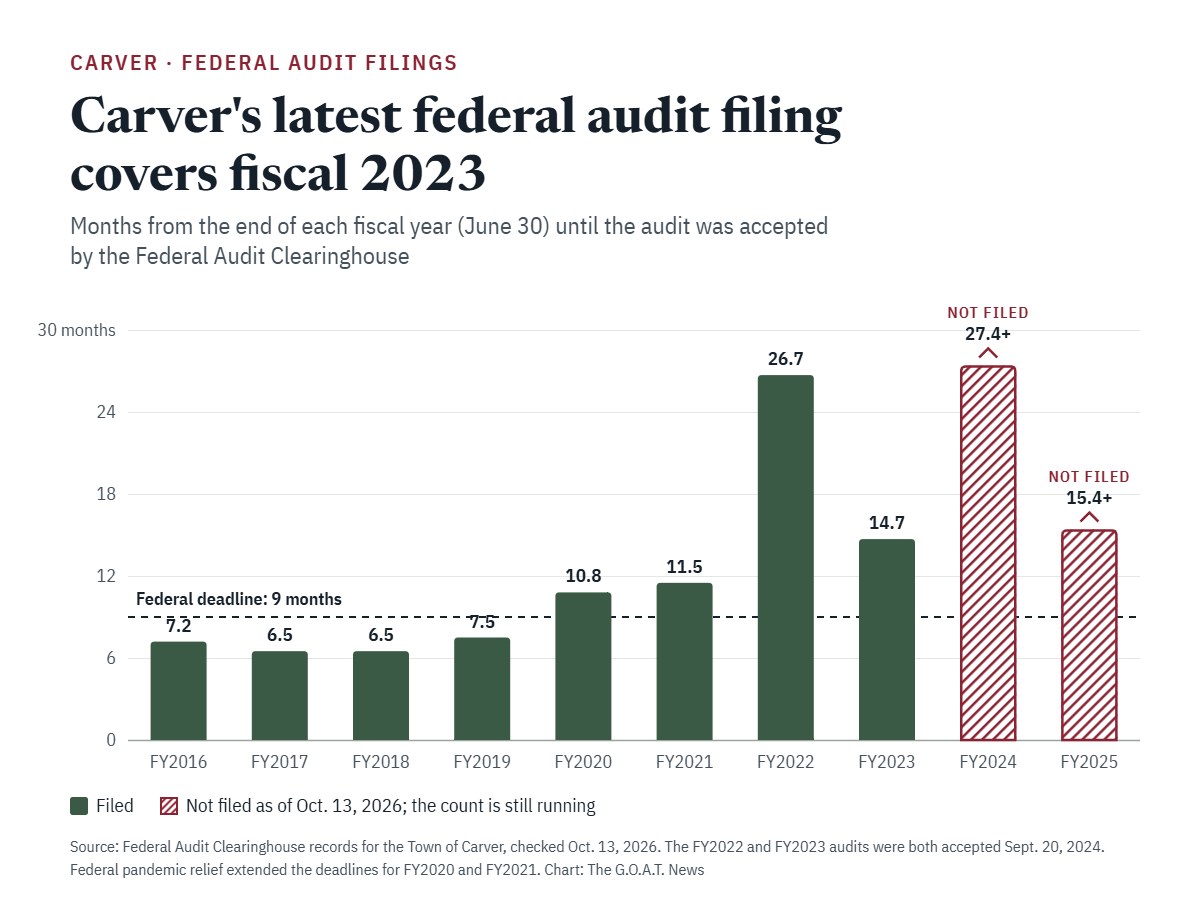
Section 3A requires a town that keeps a claims trust fund to have that fund audited every year. Gateway’s Oct. 8 agenda listed an “Audit Report Review” without saying which year the audit covers. On March 17, the Select Board voted to ask State Auditor Diana DiZoglio to “initiate an investigation and audit of the Gateway Health Group,” the minutes show. The G.O.A.T. News found no public statement from the auditor’s office on that request.
The record so far
| Date | What happened |
|---|---|
| Dec. 2025 | Gateway’s consultant warns of a deficit of up to $7 million; Carver’s share is about $4 million. |
| March 10 | Cannon calls the projected $4 million deficit “a crisis.” |
| March 17 | Asked how the town will recoup the employees’ 25 percent, Cannon says there is no plan. Board asks the state auditor to investigate Gateway. |
| April 7 | Town Meeting approves $4 million. |
| April 10 | Board approves new plan rates, up as much as 30 percent. |
| April 21 | “No real negotiations” on the employee share; board starts the Chapter 32B process. |
| June 30 | Gateway dissolves. |
| July 7 | $80,000 moved to the legal budget for “Gateway Health group issues.” |
| Aug. 4 | Union talks continue; a “mitigation fund of around 2M” is mentioned. |
| Sept. 22 | Closed session on health insurance bargaining with all municipal unions. |
| Oct. 6 | Cannon’s letter to employees; board agenda lists a “FY 2027 health insurance deficit.” |
| Oct. 8 | Gateway board schedules an audit report review and a closed session on NFP litigation. |
| Oct. 15 | Select Board subcommittee meets on Cannon’s contract in executive session, 5:05 p.m. |
| Oct. 20 | Next Select Board meeting. |
| Dec. 1 | Special Town Meeting, 6:30 p.m., Carver Middle High School. |
Sources: Carver Select Board, Finance Committee and Gateway Health Group agendas and minutes; April 7 Town Meeting minutes; Cannon’s Oct. 6 letter.
What comes next
A Select Board subcommittee meets at 5:05 p.m. Thursday in executive session to discuss Cannon’s contract, and its agenda says it will not return to open session. An opinion column in The G.O.A.T. News earlier Wednesday urged the board to write the health insurance figures into that contract. The full board meets next on Oct. 20.
The Oct. 6 agenda also listed articles for a Dec. 1 Special Town Meeting, including unpaid bills and a supplemental appropriation. The agenda does not say whether either involves health insurance.
Questions the public record does not answer
- How many employees were sent to collections or refused care, and have those bills been paid?
- What is Gateway’s final deficit, and what is Carver’s final share?
- How would each employee’s share be figured, and would people hired since the deficit, or who have left town jobs, be charged?
- Have the unions agreed to any repayment plan?
- If employees repay, where does the money go?
- What is the “mitigation fund of around 2M,” and could it reduce what employees owe?
- Would employees share in any money recovered from NFP?
- Was the Oct. 6 agenda item about last year’s deficit, or is there a new one this year?
- Who recommended that Carver join Gateway in 2024, and what did the town review before it did?
“The Town remains committed to balancing the needs of our employees with our responsibility to the Town and its taxpayers,” the letter says. Ten months after Gateway’s warning, the town has not said how it will strike that balance.
Barrella serves on the elected Middleborough Finance Committee and the Town Manager Search Committee. Neither body has any role in Carver’s health insurance. Middleborough buys employee coverage through the state Group Insurance Commission and was not a Gateway member. Select Board Chair Mark Townsend has appeared on The G.O.A.T. Podcast, and member Sarah Hewins has been invited.

Leave a Reply