
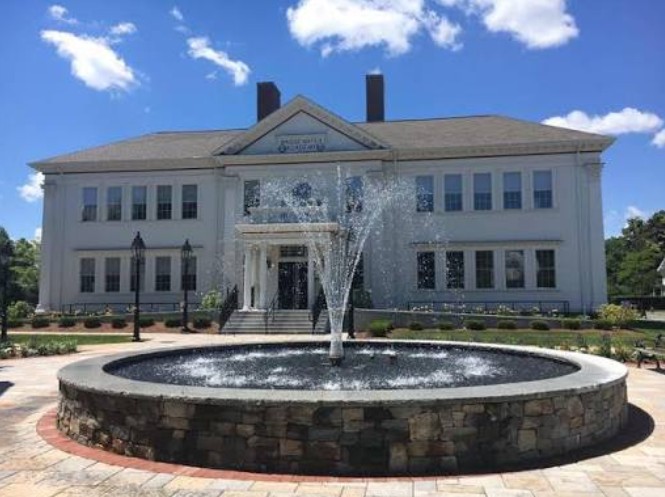
Town Council committee and Planning Board to hold joint hearing Aug. 5 on ordinance that would bar high-intensity data centers from every zoning district
By John Barrella
August 2, 2026
BRIDGEWATER — As artificial intelligence companies race to build the massive server farms that power them, a growing number of Massachusetts communities are moving just as quickly to keep them out. On Wednesday, Bridgewater will become the latest to weigh in.
The Town Council’s Community and Economic Development Committee and the Planning Board will hold a joint public hearing at 6:30 p.m. Wednesday on two proposed zoning amendments, one of which would effectively prohibit high-intensity data centers anywhere in town. The hearing, required under state law before the Town Council can act on a zoning change, will be held entirely over Zoom, with no in-person attendance permitted under the town’s continued use of pandemic-era remote meeting provisions.
The more consequential of the two measures, Ordinance D-FY26-016, would amend Bridgewater’s zoning code to define “high-intensity data center” for the first time — and then bar the use outright by designating it “not permitted” in every zoning district in town, from residential neighborhoods to industrial parks.
Under the proposed definition, a facility would qualify as high-intensity if it draws 5 megawatts or more of electricity, consumes at least 10,000 gallons of water a day for cooling, occupies 25,000 square feet or more of server space, relies on industrial-scale cooling systems, or if multiple facilities under common ownership collectively cross those thresholds. The ordinance, introduced by Councilor Paul Murphy in June, states plainly that its purpose is to protect public health, safety, and welfare by ensuring that land uses placing significant and continuous demands on municipal infrastructure are appropriately regulated.
Part of a broader trend
Bridgewater’s proposal lands amid a fast-moving statewide reckoning over the physical footprint of the artificial intelligence boom. Lowell enacted what appears to be the state’s first municipal data center moratorium earlier this year, giving officials time to study zoning rules for a technology sector that consumes enormous amounts of water and electricity to keep servers cool and running. Holyoke followed by becoming the first Massachusetts community to move toward an outright ban, and Westfield’s City Council voted unanimously this month to cement its own 365-day pause after residents packed council chambers to raise concerns about strain on the power grid, water supply, and long-term costs to ratepayers.
The debate has since reached the State House. A Worcester-area state senator recently attempted to attach a statewide, one-year data center moratorium to a sprawling economic development bill, an effort that drew more than a dozen co-signers in the Senate but ran into resistance amid concerns about forfeiting the tax and job benefits the facilities can bring.
Where those other communities have largely reached for the moratorium — a temporary pause meant to buy time to write permanent rules — Bridgewater’s approach skips that step, proposing a permanent prohibition through its zoning use table rather than a time-limited freeze.
A separate, procedural fix
The second measure on Wednesday’s agenda, Ordinance D-FY26-018, is a narrower housekeeping matter. Introduced by Councilor Mary McGrath, it would strike language in the zoning ordinance that currently lists the Town Council as a body involved in issuing special permits and reviewing site plans — authority the town’s charter does not actually grant it. The amendment would clarify that the Zoning Board of Appeals and the Planning Board, not the Council, hold that authority, and would remove the Council from a site-plan referral process laid out elsewhere in the ordinance.
Neither ordinance is up for a final vote Wednesday. Both remain in “first reading” status, and the joint hearing exists to gather public input before the measures are referred back to the Planning Board and the Community and Economic Development Committee for further review.
Why it matters
For a town of roughly 30,000 people anchored by a state university, the practical stakes of the data center ordinance may be more preventative than urgent — no such facility has been publicly proposed in Bridgewater. But that is precisely the posture other Massachusetts communities have adopted in recent months: writing the rules before a developer shows up, rather than negotiating them under pressure once an application is already filed. Lowell officials framed their own moratorium in similar terms, describing it as an effort to set clear, fair rules for everyone rather than to block development outright.
Whether Bridgewater ultimately settles on Murphy’s outright prohibition, a temporary moratorium in the mold of its neighbors to the west, or some middle path remains to be seen. Wednesday’s hearing marks the public’s first formal opportunity to weigh in.
Residents can join the hearing via Zoom at the link posted on the town’s website, or by phone at (646) 876-9923, meeting ID 873 2523 1275.
This article is based on public notices and ordinance filings published by the Town of Bridgewater, along with reporting on data center zoning debates in Lowell, Holyoke, Westfield, and at the State House from CommonWealth Beacon, WBUR, and other outlets.

Leave a Reply