
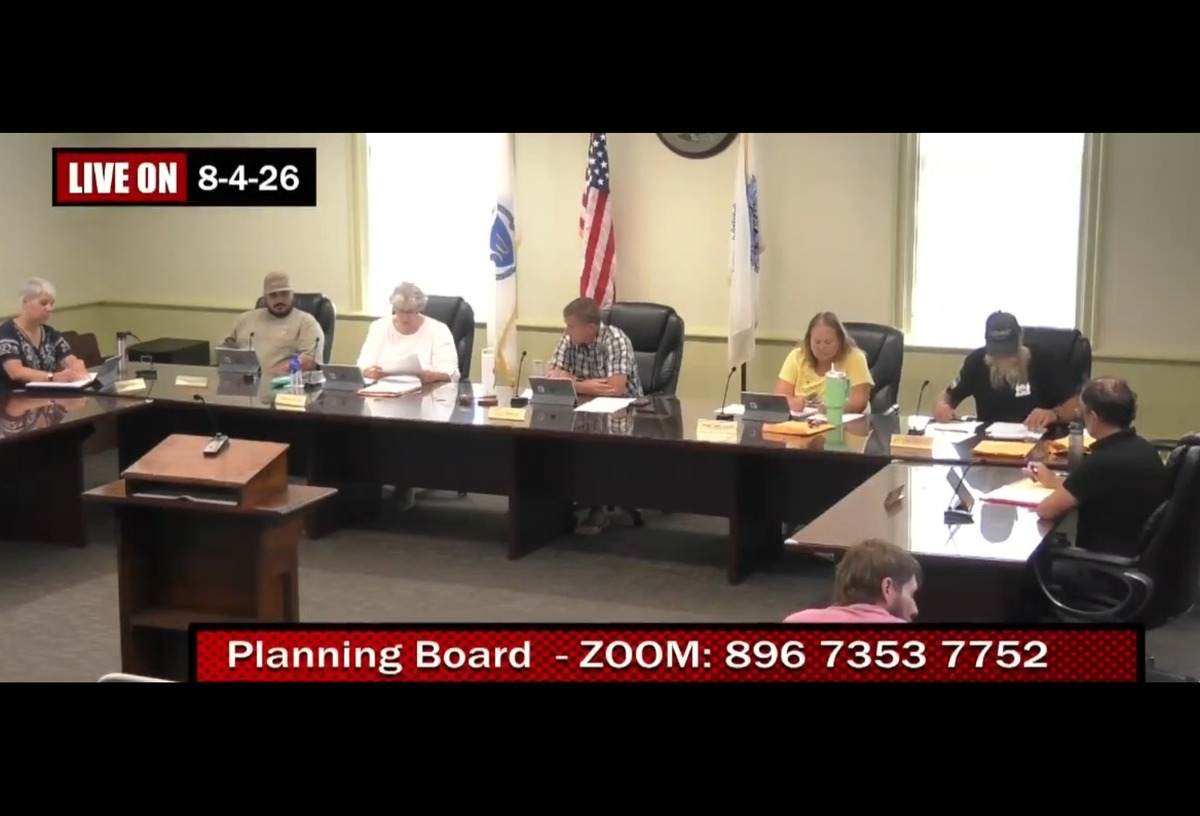
Board also grants a contested driveway waiver on Wood Street, closes out the Fall Brook subdivision, and renews pressure on the state over a still-undesigned traffic signal near Hannaford Plaza
By John Barrella
August 5, 2026
MIDDLEBOROUGH — The Planning Board voted Tuesday night to sponsor a rezoning petition for the former Freedman’s Junkyard property on East Grove Street, sending the question of whether to expand a general-use zoning designation on the 300-plus-foot-deep parcel to voters at the fall Special Town Meeting rather than deciding it themselves.
In the same meeting, the board advanced a proposed townwide ban on data centers, approved a contested request to let two “retreat lot” homes on Wood Street share a single driveway, and closed out final approval on the Fall Brook subdivision off East Main Street — while pressing the state, once again, on a traffic signal that residents say is overdue.
Freedman’s Junkyard rezoning heads to voters
Attorney Michael O’Shaughnessy, representing property owner Tim Hashim, returned to the board with an engineered site plan clarifying an earlier, less-defined request: expanding the general-use zoning designation already in place along the front of the East Grove Street parcel roughly 200 feet deeper into the property, matching the zoning boundary across the street.
“So really, what we have here in gray is the usable land area,” O’Shaughnessy told the board, noting the area includes the site’s existing junkyard operations and a drainage feature discussed at a prior meeting; the remainder of the roughly 300-foot buffer is wetlands.

Board Chairman Allin J. Frawley said he had reconsidered his earlier position on the proposal. “I think that we should sponsor this and let the wisdom of town meeting” decide, he said, rather than the board weighing the merits of a future use itself. Other members, including Nancy Kefalis and William B. Garceau, indicated they agreed with sending the question to voters regardless of their personal views on the proposed use.

Board member Tracie Craig-McGee raised a more specific concern: social media comments she’d reviewed showed support for rezoning the parcel to general use, but explicit opposition to apartments — a use permitted within the general-use category under the bylaw.
She said she didn’t want residents coming back on the board later, asking, “You sponsored this. You made it general use. Why are there apartments there?” O’Shaughnessy noted a comprehensive permit is already active on the site, meaning a future buyer could pursue development under that permit regardless of the zoning question.
The board voted 3-1 to draft the article for Town Meeting, expanding the parcel’s general-use designation to match the zoning across the street and specifying the address as 162 East Grove Street. Craig-McGee cast the dissenting vote.

Data centers move toward a townwide prohibition
Director of Planning and Community Development Leanne Bradley presented a draft zoning amendment that would add a formal definition of “data centers” to the bylaw and prohibit the use in all ten of the town’s zoning districts, calling it “the easiest article for a zoning change I’ve ever had to draft.”
Bradley told the board she’d asked the town’s counsel whether Massachusetts law permits municipalities to ban data centers outright; the question, she said, has been raised with the state before without a clear answer, since most current state mandates focus on housing production or clean energy rather than data infrastructure specifically.

Bradley said the prohibition could be reversed later if the town’s position changes, or amended if the state eventually requires municipalities to zone for the use. The board voted unanimously to approve the draft for Town Meeting.
A common driveway divides the board on Wood Street
The board’s most contentious vote of the night concerned two “retreat lot” special permits on Wood Street, where engineer Bob Forbes of Zenith Consulting Engineers, representing applicant Brandon Buote, sought permission for two separate house lots to share a single access driveway — a departure from the retreat-lot bylaw, which normally requires each such lot to have its own dedicated access route to the public way.
The goal, Forbes said, was to “reduce the total amount of impervious area, minimize tree clearing” near a bordering wetland.

Kefalis pressed on how much of the shared driveway route had already been cleared, and whether Zenith’s written justification still held up given that some clearing had already occurred. Buote said only the first roughly 150 feet nearest the road had been cut, well outside the 100-foot wetland buffer. Kefalis said she was “in no hurry to start putting restrictions on what people can do” on their own property, while also raising concern about setting a precedent for future retreat-lot driveway-sharing requests.
Craig-McGee noted the board had approved a similar shared driveway for two retreat lots off Precinct Street previously, meaning the arrangement wasn’t unprecedented. Kefalis raised a separate question about whether the board could restrict future tree-clearing on the property at all, given accessory dwelling unit provisions that give property owners rights the board can’t easily override.
The board voted 4-1 to approve both waiver requests, with Craig-McGee opposed.
Fall Brook subdivision gets final sign-off
O’Shaughnessy also returned on behalf of NESP LLC with a final engineering letter from the town’s peer-review consultant, Apex Companies, confirming the Fall Brook subdivision off East Main Street had addressed all outstanding technical comments.
The board worked through a lengthy list of requested waivers from the town’s standard subdivision regulations — covering everything from pipe materials to street tree placement to boundary monument specifications — nearly all of which reflected the project’s status as a private commercial roadway rather than a residential street eventually turned over to the town. One board member noted the tree-preservation waiver marked a departure from the board’s two most recent comparable commercial subdivisions, Charlotte Court and Campus 44, both of which had been required to preserve tree areas; O’Shaughnessy said he was open to either approach, and the board approved the full waiver list without altering that item.
Planning Board member William Garceau asked what would prevent a future request to have the road accepted as a public way, given the waivers granted. O’Shaughnessy and Bradley said the subdivision decision explicitly designates the roadway as permanently private, consistent with the town’s approach to the Campus 44 industrial park.
The board voted unanimously to close the hearing, approve the waiver list, and accept the certificate of approval for the definitive subdivision plan.
Renewed pressure over a still-undesigned traffic signal
Early in the meeting, board member Tracie Craig-McGee raised a recent close call near Hannaford Plaza, in which a driver’s shouted warning prevented a pedestrian from being struck. Bradley told the board the state’s design work on a signal for the intersection remains at only 25 percent completion, despite the timeline having already been moved up once, from 2030 to 2029.
Craig-McGee pressed for the town’s state legislative delegation and the Southeastern Regional Planning and Economic Development District to push for the project to be accelerated into 2028, invoking the town’s yearslong history of fatal accidents at the Wood Street intersection before a signal was finally installed there, and urged residents to contact their state legislators directly.
Frawley, responding, said state design timelines don’t move quickly regardless of local pressure, but agreed the board should continue pressing the issue.
Other business
Bradley confirmed for the board that ABC Residential Properties’ proposed 275-unit 40B apartment complex on the former drive-in property has been formally withdrawn, following the town’s successful argument to the state that Middleborough’s affordable-housing inventory — currently at 10.79 percent — is being actively maintained above the required 10 percent threshold. The next statistical recalculation isn’t expected until after the 2030 census, with final numbers likely in 2031.
The board also approved a routine lot-line adjustment on Old Center Street, granted six-week extensions on two pending retreat-lot applications on Moulton and Carey streets, and heard a brief update from Bradley on a proposed statewide natural heritage habitat map now open for public comment through October 4.

Leave a Reply