
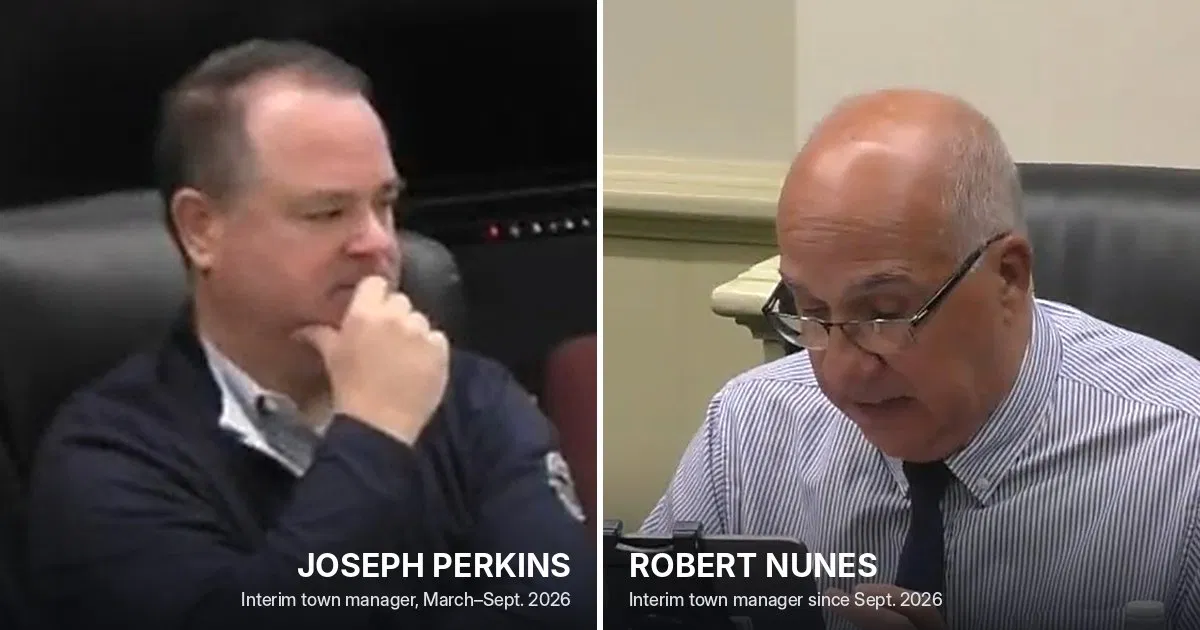
Joseph Perkins found the hole in March. Two weeks into his return, Nunes has explained one of the town’s money problems and been straight about the one that can’t be explained yet.
By John Barrella
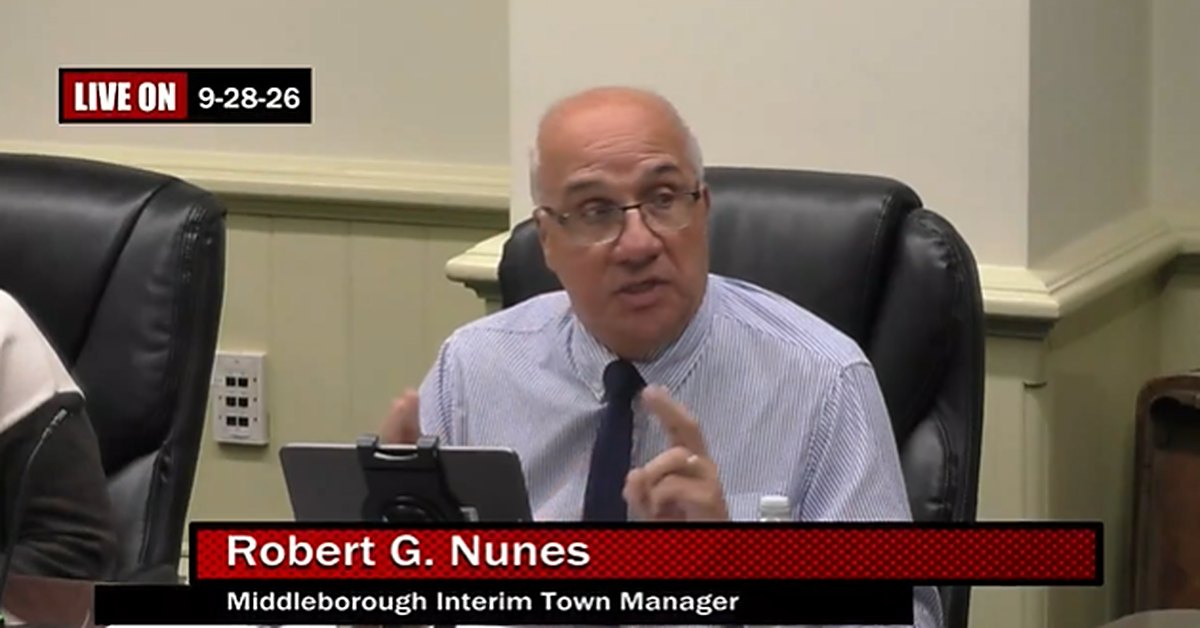
It isn’t often a town manager says “the good news” right before reporting a $682,000 shortfall. Robert Nunes did it at the Select Board’s Sept. 28 meeting, and he meant it.
Middleborough’s water and trash funds closed fiscal 2026, the year that ended June 30, that far in the red. But the money came in as expected, Nunes explained. The budget was wrong. “The good news is that it was not a revenue deficit. It was a budget deficit,” he said. “So we received enough revenue to pay the expenses.” He traced the gap to the indirect charges those funds pay the town for shared services.
He plans to cover it from the funds’ own retained earnings, which takes a Town Meeting vote. Because revenue covered expenses, he said, the gap won’t cause trouble with the state when the tax rate is set. He also found that the fiscal 2027 indirect charges for water and wastewater, approved by voters in June, were wrong as well. They will be corrected in November.
That is a problem with an identified cause and a plan to fix it. It isn’t a clean bill of health.
The figures behind it are unaudited, and they come from the same books the auditors have flagged for problems with journal entries and enterprise fund reporting. The town’s cash is still being reconciled. The fix depends on retained earnings the state hasn’t certified yet. Nunes said he’s “very confident” they’ll come back positive. If they don’t, the gap will have to be covered some other way, possibly through higher water and trash rates or on next year’s tax rate.
There’s a mirror image, too. If the indirect charges were too high, as Nunes suspects, water and trash customers were effectively helping carry the general fund. Lowering those charges means the general fund loses money it had been counting on. That shortfall has to land somewhere, and residents deserve to know where before they vote on Nov. 9.
And the budgets themselves missed. The one voters approved for fiscal 2026 didn’t hold, and the fiscal 2027 charges approved in June were wrong too. A budget that misstates its own costs is a control problem of its own. Even the fund’s clean history comes with a caveat: Nunes said he’d been told the water fund didn’t run a deficit in fiscal 2024 or 2025, “at least on the town’s books.”
Those are open questions about a problem whose cause has at least been identified.
Fiscal 2025 is a different story.
Fifteen months after fiscal 2025 ended, there is still no audit of it. The last fiscal year the town has audited ended June 30, 2024, and the full account of what went wrong won’t be known until this audit is finished. At a joint meeting on Sept. 21, Nunes told the Select Board and Finance Committee what it will contain: material weaknesses in the town’s financial controls, along with problems in financial reporting, journal entries, debt management and the enterprise funds. “The audit is late,” he said. “But more importantly, the findings will be serious and a lot is at stake with this audit.”
A material weakness is the most serious finding an auditor makes. It means there’s a real chance a significant error gets through without being caught in time.
At the Sept. 28 meeting, he reported that the auditors now want records going back to fiscal 2021. He hasn’t said why, but a lookback that long is typically how auditors find the last point where the books were known to be right. They are billing $45,000 more for the extra work. Standard & Poor’s declined to hold a ratings call without a finished audit, and Nunes said he’d be shocked if the town isn’t downgraded.
So there are two problems. One is a budgeting mistake with an identified cause and a planned fix, though the numbers behind it still need checking. The other is a set of audit findings whose causes are still unknown. Nunes has kept them apart and put both on the record, in public, in plain terms. It isn’t comfortable listening. It is exactly what the town needs.
The Select Board voted Aug. 31 to bring Nunes back as interim town manager. He ran Middleborough from 2014 to 2022 and later served as Lakeville’s town administrator. Before that, he worked at the state Department of Revenue’s Division of Local Services, the office that sets the accounting rules every Massachusetts town operates under. When he left in 2022, state records show the town’s certified free cash stood at about $6.4 million.
He has been just as direct about the rest. He disclosed a $161,769 pandemic-era deficit the state is requiring the town to cover this year. And he said plainly that the treasurer-collector and assistant treasurer-collector jobs were both vacant and that the town couldn’t go on that way much longer. On Sept. 28, he told the board that interviews were showing progress. The Select Board’s agenda for Monday, Oct. 5, now includes a vote to ratify a new treasurer-collector.
Plenty of officials would spend weeks deciding how to phrase some of that.
Nunes said it on the record, at recorded public meetings, and then told the board what he plans to do. He has recommended bringing in outside help on the audit findings and on how indirect costs are calculated. He has set up an internal team on the town’s MUNIS accounting software that will meet every two weeks. And he has asked public works department heads to recheck their budgets so this year doesn’t end the way the last one did. At his request, the board also moved Special Town Meeting to Nov. 9 to give at least nine finance articles more time. “I just didn’t want to rush,” he said.
Credit belongs to his predecessor, too, and how he found the problem is worth remembering.
Retired police chief Joseph Perkins took over as interim manager in March. At a joint meeting of the Select Board, Finance Committee and School Committee on March 9, I told him, in essence, that the budget in front of him was now his, and that before anyone touched a single teacher’s line item, the whole budget should be reviewed line by line. I had been raising questions about the town’s finances for more than a year, and I didn’t want teachers to be the first place the town looked for savings. Much like a good detective, Perkins took up the challenge.
A week later, on March 16, he told the Select Board he was “not comfortable with the budget as presented,” that he believed it was “out of balance significantly” and that there was a deficit. He put the shortfall at about $3.3 million. Among other problems, the fiscal 2027 budget he inherited counted on roughly $1.5 million more in local receipts than he believed the town would collect. He found all of it while saying openly that municipal finance wasn’t his field.
None of this makes Nunes a miracle worker. The audit isn’t finished. Free cash, in his words, is “most likely to be positive, but it’s not going to be a large number.” My own read is more cautious. Between the pandemic-era deficit, the cash still being reconciled and how optimistic recent revenue estimates have been, there may not be any.
The hardest votes are still ahead. Candor is a start, not a solution. I expect Nunes to follow through; in two weeks he has shown every sign of wanting to be transparent. But residents should hold him to it.
First, put it in writing. Nunes has agreed to give residents regular updates. Make them a monthly written report on the town website covering audit status, cash reconciliation, free cash, borrowing and vacancies, so the public record doesn’t depend on who happened to watch which meeting.
Second, before Nov. 9, publish a plain-language explanation of every finance article on the warrant: what it fixes, what it costs and what happens if it fails.
Third, make the consultants’ work public: what they’ll examine, when they’ll report and what they find.
Repairing the books is one job. Explaining how they got this way is another, and residents will eventually deserve both. Neither happens without someone willing to say out loud what’s wrong, what went wrong and why.
“We still have time,” Nunes told the board on Sept. 28. He’s right, as long as he keeps telling us exactly how much.
John Barrella is an elected member of the Middleborough Finance Committee, which will make recommendations on the Special Town Meeting articles described here, and serves on the town’s Town Manager Search Committee. He spoke during public comment before the Select Board’s Aug. 31 vote on Nunes’s appointment. He owns and publishes The G.O.A.T. News in Middleborough and writes for himself, not for either committee.

Leave a Reply