
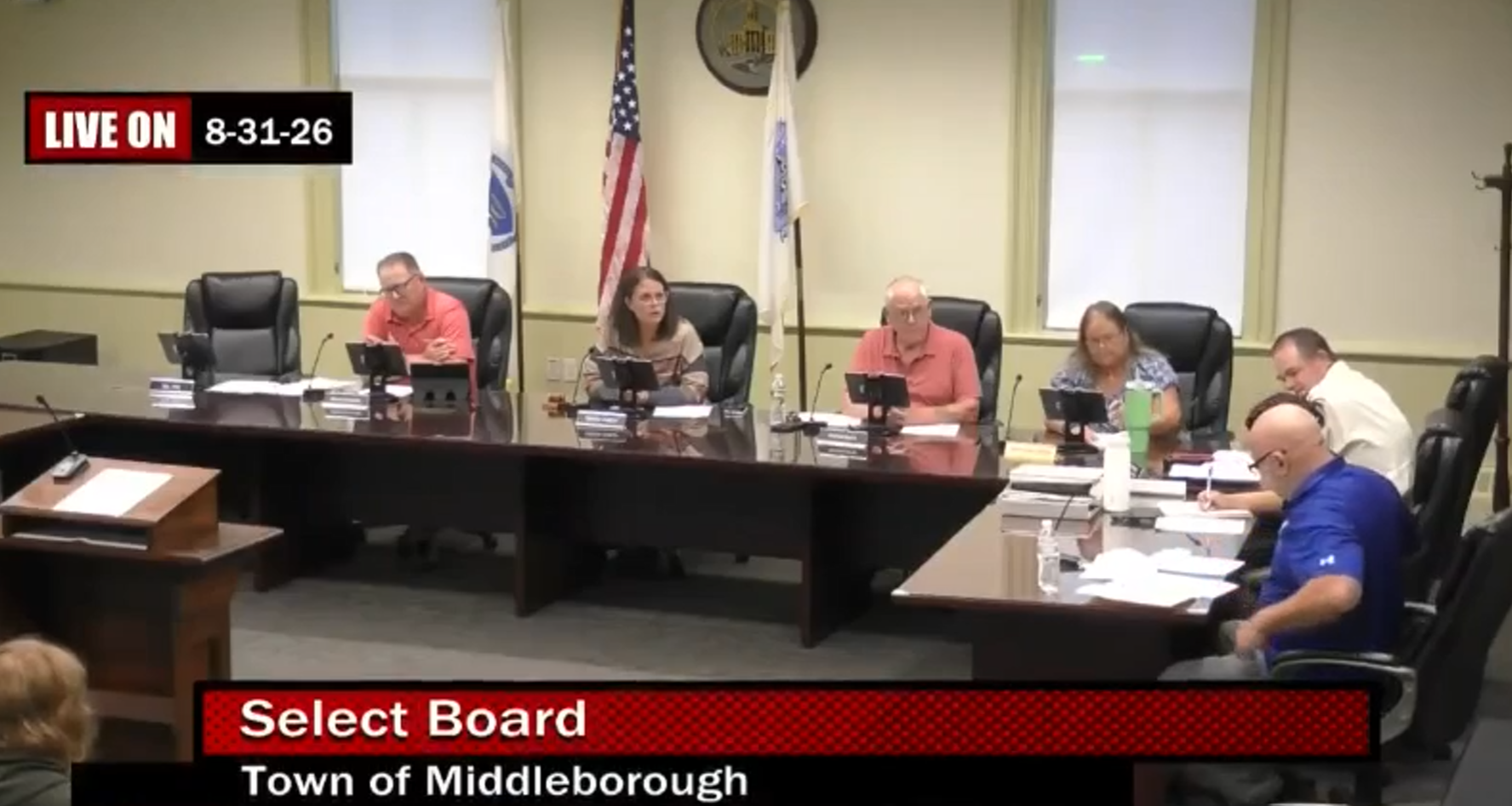
Robert Nunes, who led Middleborough before Jay McGrail and brings decades of municipal government experience, was tapped Monday as interim town manager on a 3-1 vote, as the town’s financial picture grew more uncertain.
By John Barrella
MIDDLEBOROUGH — Five months after outgoing Town Manager Jay McGrail’s budget projections were found to be off by more than half a million dollars — a discrepancy serious enough that the town’s Finance Committee recommended the Select Board commission a forensic audit into the town’s finances — Middleborough’s financial troubles deepened again Monday night, as the Select Board learned that this year’s independent audit will not be finished in time for the town’s bond rating call. In the same meeting, the board voted to bring back the town manager who preceded McGrail to help steer the town through it.
The board voted to install Robert Nunes — who led Middleborough from November 2014 to October 2022 before handing the job to Jay McGrail, and who most recently served as town administrator in Lakeville — as interim town manager once current interim manager Joseph Perkins’s contract ends September 30.
The vote came after nearly an hour of public debate over Nunes’s record, and passed 3-1, with Select Board member Brian Giovanoni casting the lone dissent. Board member William Pike was absent, recovering from an unexpected hospital stay; Select Board Chair Teresa Farley asked that the record reflect the town’s well-wishes for his recovery.
The appointment came on a night when Perkins delivered a far heavier piece of news:
the town’s outside auditor has told the town it cannot complete the fiscal year 2025 audit in time for Middleborough’s upcoming bond rating call, a delay that could complicate the town’s borrowing costs and, Perkins said, will require the town to roll over short-term debt for several more months. Compounding the uncertainty, Perkins told the board that the town’s treasurer — whom this outlet has confirmed to be Erika Correia — has submitted her resignation effective next Friday, leaving Middleborough without a permanent town manager, a certified audit, or a treasurer at the same time.
An audit that won’t finish
Perkins told the board he learned of the delay in a phone call about two weeks earlier from the town’s audit firm, which he identified as CBIZ.
“I notified you last Wednesday of a phone call that I received on Monday, the 17th or 18th, from our audit vendor, CBIZ — the principal managing partner, Mr. McIntyre, and our auditor, Mr. Nolan,” Perkins said. “They called and advised that they were unable to complete the audit in time for our ratings call, and they felt that they needed to inform the individuals that are responsible for the governance of the town — the Select Board and the Finance Committee — of the issue.”
Perkins, a retired Middleborough police chief who has repeatedly told the board he lacks formal financial training, said he deliberately avoided characterizing what the delay might mean for the town, sticking to the auditors’ own language.
“I tried not to editorialize anything they said, because I did not want to be overblown or understated,” Perkins said. “But I did not take it to be a positive conversation, based on the importance that they were placing on the notification.”
Perkins said the audit firm laid out two options for the board, without recommending either: permanently finance the town’s outstanding debt over a 20-year period, or roll over the town’s bond anticipation notes for three to six months until the fiscal 2025 audit is complete. He said the town’s financial advisor, Hilltop Securities, recommended the short-term rollover after a call with Finance Director Susan Nickerson and the treasurer.
“I would recommend back to the board, both Finance Committee and Select Board, that we should probably go with what the experts are telling us to do,” Perkins said.
Perkins said the audit firm traced the errors to a March 2025 changeover in the town’s accounting software and a previous employee who had reported revenue to the finance office “in incorrect amounts” with faulty data entry.
Finance Director Susan Nickerson has been working to manually trace and reconcile the errors, a process auditors described using the term “debt mapping,” Perkins said.
The audit delay lands on top of an already sizable pipeline of borrowing still to come. Massachusetts Department of Revenue Division of Local Services data show Middleborough carrying total authorized debt of roughly $105 million to $118 million in each of the past four fiscal years — but a substantial share of that authorization remains unissued, meaning town meeting has approved the borrowing but the town has not yet actually sold the bonds or notes.
That unissued balance has swung from roughly $20 million in fiscal 2023 up to roughly $60 million in fiscal 2024, and stood at an estimated $55 million, or about half of all authorized debt, in fiscal 2025. (DLS had not yet posted fiscal 2026 figures as of this writing.) Unissued authorization matters because it represents borrowing the town is effectively committed to eventually completing — likely tied to capital work already underway or pending, including the East Grove Street water treatment plant, the North Street water main and the well project described above, and the proposed Nichols Middle School roof replacement — and each dollar of it will add to the town’s debt service, and ultimately its tax levy, once issued.
Rating agencies typically factor a large unissued pipeline into their view of a community’s future debt burden, which can carry extra weight when it arrives, as it has here, alongside a stalled audit and open questions about the finance office’s own numbers.

The finance office’s difficulties are not new. This spring, Perkins found that the roughly $112 million budget prepared by McGrail overestimated state aid by about $533,000 and understated a state assessment by roughly $800,000, among other gaps, forcing the town to rebuild the budget before it went to town meeting.
Perkins added that the finance office is now further strained by the resignation of Treasurer Erika Correia, whom he did not name at the meeting, effective next Friday. “This is another hurdle that we need to overcome financially,” he said. “It’s really all hands on deck.”
A contentious return
The board’s decision to bring back Nunes came after member Tracie Craig-McGee moved to appoint him, citing his prior tenure in Middleborough and what she called his “financial acumen.”
“I worked with Bob for a year over in another town, and I was amazed at his financial acumen,” Craig-McGee said. “We need somebody who knows Middleborough, who knows our strengths, our weaknesses. I think the residents would have a level of confidence in him as well, seeing as the financial position he left us in when he did retire.”
Select Board member Thomas White said he had reached out to Nunes personally over the weekend before endorsing him. “Bob assured me that if he was the candidate, he would not disparage or do anything to down Middleborough while he was here,” White said. “He was coming here strictly to help us with our financial issue, and I’m taking the man at his word.”
Giovanoni, who said he worked alongside Nunes for roughly four years on the board, was the only member to speak against the appointment, and cast the only recorded no vote.
“I won’t be voting for Bob Nunes,” Giovanoni said. “That man knew nothing but borrow money — have this big wad of cash in his pocket, but everything went on the credit card in this town while he was here. It took someone else to come in here and put money away into our rainy day account to get us to a double-A rating.”
Town and S&P Global Ratings records reviewed by this outlet tell a different story on the bond rating specifically:
Middleborough’s rating was upgraded from AA- to AA in March 2014 — about eight months before Nunes’s own tenure as town manager even began that November, and more than eight years before McGrail’s — and has not changed since, including a reaffirmation as recently as 2025. The record shows no rating change during either Nunes’s tenure (November 2014 to October 2022) or McGrail’s.

On the “rainy day account” itself, state data tell a more complicated story than Giovanoni’s framing suggests.
Figures maintained by the Massachusetts Department of Revenue’s Division of Local Services show Middleborough’s stabilization fund — the town’s rainy-day reserve — never came close to empty over the past 15 years, holding between roughly $1.5 million and $3 million, or between about 2.5% and 4.2% of the operating budget, in every fiscal year from 2011 through 2022 — a span covering the entirety of Nunes’s tenure as well as the years before it.
The balance then jumped sharply, from $2.9 million in fiscal 2022 to $5.9 million in fiscal 2023 — a fiscal year that began under Nunes that July but was overseen mostly by his successor after Nunes left office that October — and has continued climbing since, reaching a combined $6.8 million, 6.6% of the budget and the largest share of any year in the data, by fiscal 2025.
If anything, the timing runs opposite to Giovanoni’s framing: the reserve held flat through Nunes’s years in office and grew mainly after he left. That runup also coincides with a period in which Middleborough, like municipalities across Massachusetts, received one-time federal COVID-19 relief funding, which typically flowed through local budgets as CARES Act and American Rescue Plan Act dollars in the years just before it — a factor that could account for some of the increase independent of any town manager’s individual record.

Public comment on the appointment ran long and, at times, sharp.
Finance Committee member Matt Phillips of Old Center Street argued the board was overlooking Nunes’s record. “When Bob Nunes left the town, we had over $6 million in free cash. When Jay McGrail left the town, we were staring down a $3.5 million deficit — according to my Sesame Street math, that is $9.5 million,” Phillips said, prompting an objection from Farley that the comparison amounted to an unanswered accusation the board would not litigate from the floor. A brief, heated exchange followed between Phillips and Giovanoni over where the $6 million in free cash had gone; Farley cut off the discussion, saying it was not the proper forum.
Phillips’s two figures hold up only partially against the public record. His free cash figure checks out: state Division of Local Services data show Middleborough’s certified free cash at $6,375,458 for fiscal 2022, the year Nunes’s tenure ended, and it climbed even higher, to $7,889,078, the following year before collapsing to just $1,615,168 in fiscal 2024 — a swing that lines up with the town’s broader financial turbulence under McGrail — and recovering only partially, to $3,144,393, in fiscal 2025.
The $3.5 million deficit Phillips attributed to McGrail, however, runs somewhat higher than the $3.3 million town-level shortfall Perkins himself cited to the Select Board that March — a figure reported by the Cape Cod Chronicle and elsewhere, and separate from an additional $2.2 million shortfall in the school budget that Phillips’s figure does not appear to include.

Oak Point residents Paula Fay and Diane Fay both described positive experience working with Nunes on municipal committees and urged the board to select him. “I served on the Finance Committee under Mr. Nunes. The man knows his financial background,” Paula Faye said.
Adam Bond, a Rock Street business owner and local attorney who said he is not a Middleborough resident, praised Perkins’s integrity but argued the board’s real problem predated any one manager. “There were a lot of hands in this pot making this soup,” Bond said, adding that whoever is chosen, “you don’t have to love the man, but if he can yank our butts out of this fire, God bless.”
Resident Sue Pennini of 2 Muttock Lane urged the board to slow down and weigh other candidates before committing. “This is not where Middleborough is going to be in 20 years — this is to get us through an interim period,” Pennini said. “Do any of them have the financial expertise to do that? And do they have the leadership capability to bring people together?”
John Barrella, publisher of The G.O.A.T. News, also addressed the board during public comment, citing Massachusetts Department of Revenue Division of Local Services data on Middleborough’s certified free cash usage from 2017 through 2025 and the town’s stabilization fund balance as a share of the budget over the same period, without drawing a conclusion from the figures.
Perkins himself declined to weigh in on Nunes’s candidacy, telling the board he lacked the expertise to evaluate the town’s finances. “I do not understand the depth of what I’m being told, and I believe what I’m being told is very bad,” Perkins said. “I can balance your budget, your checkbook — that’s it.”
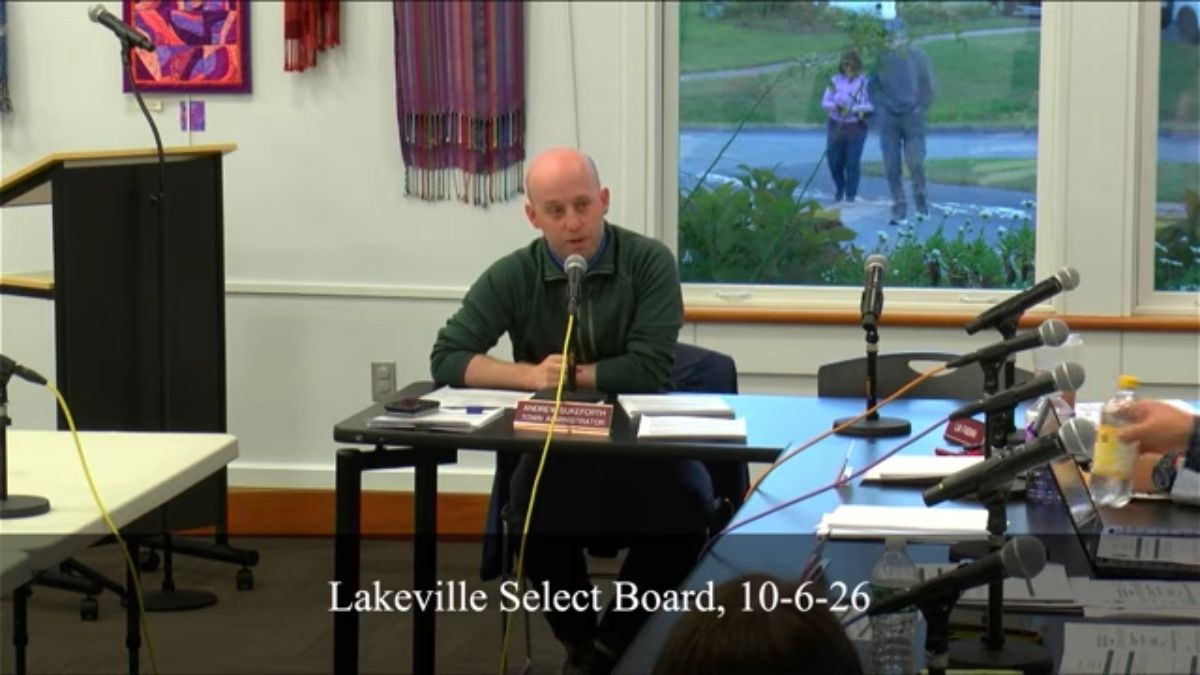
Perkins said Nunes was one of five people with financial experience he had consulted informally while preparing his own budget analysis, along with former Rochester town administrator Rich La Camera; former Lakeville selectman and Canton Finance Director Randy Scollins, whose title as of this writing this outlet could not confirm amid indications he may have since retired; retired former Middleborough town accountant Steve Dooney; and current Lakeville Town Administrator Andrew Sukeforth.
Following the vote, the board separately voted, unanimously, to authorize Farley to negotiate a contract with Nunes with the assistance of labor counsel, and asked that Perkins be included in those negotiations.
The permanent search continues
Mr. Joe Mandile, who chairs the town’s search committee for a permanent town manager, told the board the committee has begun reviewing all 31 applications submitted for that position and is meeting weekly, on Wednesdays, to narrow the field.
After discussion, the board voted to reopen the town manager posting until September 30 — rather than choose from the existing pool immediately — reasoning that some applicants may not have been able to commit to a start date over the summer but could reconsider once the town’s financial picture, and an interim manager’s start date, are clearer. The search committee will continue meeting and reviewing candidates in the meantime, with an eye toward overlapping a new search with the end of Nunes’s interim tenure, which board members estimated at four to six months.
Also Monday
Capital projects. The board authorized change orders totaling roughly $201,000 on the East Grove Street water treatment plant project, now underway for about 14 months, covering items including additional excavation, a drainage conflict with an adjacent YMCA stormwater basin, a building setback required after propane delivery trucks were found to have too little clearance in an alley, and disposal of a decommissioned 1918 coke filter that could not be accepted locally and had to be trucked to New Hampshire as contaminated waste.
Michael Bumpus, the Town’s Water superintendent told the board the additions were offset in part by roughly $57,000 in credits from other scope changes. “I prefer to see things like that — not just, hey, would you have given the contractor some free money? Because that’s not what this is,” he said.
The board also awarded a $3,123,045 contract to Oliveira Construction for the North Street water main replacement, expected to begin shortly after Labor Day, and a $214,528 contract to Weston & Sampson for construction of two new supplemental wells that could eventually supply as much as 400,000 additional gallons a day once connected to the town’s new treatment plant.
Special town meeting. The board reviewed a draft warrant, still pending town counsel and bond counsel review, for a special town meeting scheduled for October 19. Articles under consideration include: sick-leave buyback for two retiring police officers; a town-wide ban on data centers in all zoning districts, proposed by the Planning Board; a rezoning of a portion of the former Friedman’s Auto Salvage property from residential to general/commercial use, requested by attorney Michael Shaughnessy on behalf of a client; a state-mandated battery energy storage system zoning bylaw, due by December 1 under the Commonwealth’s 2024 clean energy law; formal roadway acceptance of Morton Street and Grace Street; re-bidding of wastewater treatment plant slide-gate repairs after the town’s sole bidder came in at $430,000 against a $200,000 budget; replacement of the Wood Street sewer force main, which serves Ocean Spray’s plant and has failed twice; a placeholder article on the town’s water-sharing agreement with Carver; and a roughly $2.8 million roof replacement at Nichols Middle School, toward which the Massachusetts School Building Authority has pledged a $2.14 million grant. School Committee Chair Sue Pennini urged the board to keep the roof project on the October warrant rather than delay to next spring, saying a delay could cost the town its MSBA funding award.
A separate article would remove the requirement that the town publish its town meeting warrant in a newspaper of general circulation, relying instead on postings at Town Hall, the library, post offices and the town website — a change Perkins said would save the town about $10,000 a year.
Fuel and asphalt storage. The board held four public hearings and approved, without objection, new above-ground and underground fuel storage licenses for a industrial site at 400 Canopy Drive: up to 8,000 gallons of propane for Devaney Energy; roughly 10,000 gallons combined of gasoline and diesel for La Mountain Brothers Inc.; 2,100 gallons of motor and used oil for John Travis Industries; and performance-grade liquid asphalt storage, also for John Travis Industries. Interim Fire Chief Dana Fontaine told the board her department had toured the applicant’s existing facility and had no safety concerns.
Liquor licenses. The board approved one-day beer and wine licenses for two Harper Lane Brewery events and for a Bog Side Acres LLC event at the Barn at Benson’s Pond, with Farley abstaining from the Harper Lane votes because the events are held at her employer’s property. The board postponed action on a separate one-day all-alcohol license for Bog Side Acres after board members determined the applicant had sought approval for all-alcohol service without confirming nonprofit status required for that license type; the board asked for additional documentation before its September 14 meeting.
Also: The board appointed Rose Buzzell to the Commission on Disability for a term expiring June 30, 2027, after her earlier letter of interest went unanswered for several months; voted to advance the layout of Morton Street and Grace Street as public ways to the Planning Board, as part of the Morton Estates subdivision off Old Center Street, with developer Marcus Baptist of Old Beach Investments on hand — Farley thanked Baptist for agreeing to donate an undeveloped portion of the property to the Conservation Commission rather than building on it.
Correction: Because of an editing error, an earlier version of this article misidentified the Middleborough School Committee chair as Sue Kennedy of Tumeric Lane. She is Sue Pennini of Muttock Lane. The G.O.A.T. News regrets the errors.
Disclosure: John Barrella, owner, founder and publisher of The G.O.A.T. News, is the author of this article and also serves on two Middleborough town bodies discussed in it. He sits on the Finance Committee alongside Matt Phillips, whose public comments on the Nunes appointment are quoted and fact-checked above. He also sits on the Town Manager Search Committee referenced in “The permanent search continues” section, which is currently reviewing the 31 applications submitted for the permanent town manager position. Separately, Barrella addressed the Select Board himself during the public comment period covered in this article, citing state data on the town’s free cash and stabilization fund history. The financial figures and fact-checks throughout this piece are drawn from primary sources — the Massachusetts Department of Revenue’s Division of Local Services, S&P Global Ratings, and other public records — independent of Barrella’s committee roles, but readers should weigh those roles in evaluating this coverage.

Leave a Reply