

Carver · Investigation
Six months before a health insurance deficit appeared on the Select Board’s October agenda, a board member stood at Town Meeting and predicted it. He also told voters the cause was the town’s own budgeting, not the consultant the town has blamed since.

CARVER — On Oct. 6, the Select Board’s agenda carried a new line: “Discussion on FY 2027 health insurance deficit.” It was the second health insurance shortfall to reach the board in a year, and it arrived almost exactly when a member of that board had said it would.
At the April 7 Annual Town Meeting, during debate on the $54.5 million operating budget, John Cotter told the hall the town was about to repeat the mistake that produced the first deficit. “You’re going to hear tonight a lot about a health insurance deficit, and from what I can tell, the general cause was us not budgeting enough health insurance increase in our prior budgets,” he said, according to the Area 58 recording of the meeting. “I think we’ve used low numbers like 8, 9%. I think that’s extremely low. It should be somewhere around 18% or 20%.”
Then he told voters what that meant. “I think we’re going to be coming back to see you in the fall because I think we’re going to have some serious deficits based on this budget.”
The G.O.A.T. News reviewed the full three-hour, 13-minute recording of the April 7 meeting against the Select Board’s posted minutes, the town’s prior statements and Town Administrator Glenn Cannon’s Oct. 6 letter to employees, first reported by The G.O.A.T. News on Oct. 14. The recording shows a debate that the minutes do not capture, in which the town’s own account of the crisis was contradicted from the floor, a quarter of the $4 million was challenged as improperly sourced, and the town’s lawyer told voters Carver had no legal duty to audit a fund the same lawyer said minutes later was supposed to have been audited.
Two explanations, one night
The town’s public account has placed the cause outside Carver. Presenting the health insurance article, Cannon told voters the joint purchasing group Carver shared with Lakeville and the Old Rochester Regional School District “retains a professional consultant to advise them on setting rates,” and that “we have serious concerns about how the Gateway Group was advised by the consultant and have replaced that consultant.” In March, Select Board Chair Mark Townsend named the consultant as NFP and said in a statement read into the record that “it is clear that NFP has completely failed.” Cannon’s Oct. 6 letter says the deficit “resulted from the Gateway Health Group consultant recommending a low-rate increase.”
Cotter’s account, delivered about 30 minutes earlier in the same meeting, located the cause inside the town’s own budget documents. He said Carver had assumed health insurance increases of 8 or 9 percent in prior budgets when the figure should have been closer to 18 or 20 percent, and that the practice went back years. “I don’t want people to think that this happened in one year,” he said during the health insurance debate. “This is something that’s gone back multiple years. It’s gone back because our estimates have been too low every single year.”
No one from the town responded to that explanation on the floor. The posted Select Board minutes do not record it.
The trust fund the town says it does not have
The sharpest exchange of the night came when a resident asked a question the minutes reduce to nothing: where had the employees’ and the town’s contributions been going, and what was in the claims trust fund.
“The town of Carver should be auditing their claims trust fund every year,” she said. “We’re self-insured. Where have they been going? We’re fiduciaries of that trust fund and the treasurer should be putting them into a trust fund. What’s that number?”
Town labor counsel John Clifford, of Clifford and Kenny, answered that the question rested on a false premise. “The town of Carver does not operate a claims trust fund themselves,” he said. “We participate in a joint purchasing group. They maintain the trust fund.” He went further: “We do not maintain a separate trust. We do not have an obligation under chapter 32B to maintain a trust or to have it audited. We treat this like other budgeted items. We’re paying a third party to provide that service.”
Cannon agreed. “We are not self-insured specifically by the town of Carver,” he said. “Again, we pay a third party for our claims. They’re administrators.”
Earlier the same evening, presenting the article, Cannon had described the arrangement differently. “The health care coverage is technically not insurance,” he told voters, “as the money the town employees pays covers the claims for services and there is a major deficit to fund in the fund to pay for claims.”
About fifteen minutes after saying the town had no duty to audit, Clifford described the new carrier, the Massachusetts Interlocal Insurance Association, to another resident. MIIA’s members, he said, “are actually audited every year as the Gateway Group was supposed to be audited.”
The statute is Chapter 32B, Section 3A, which requires a governmental unit with a claims trust fund to have it audited annually, and Section 12, which applies those requirements to a town that joins a joint purchase group. It is the same chapter Cannon invoked six months later, in his Oct. 6 letter, to tell employees the law “requires that the Town adjust future employee contributions to cover the employee share of the projected final deficit, which is about 25% of the $4 million deficit, or $1 million.”
In April the town told voters Chapter 32B imposed no auditing duty on Carver. In October it told employees Chapter 32B imposed a $1 million duty on them.
A quarter of the money, challenged and unanswered
The $4 million came in two motions. The first raised $1,510,295 on the fiscal 2027 tax levy and passed 118 to 30. The second transferred $1,465,785 from fiscal 2026 free cash and $1,023,920 from what the motion called “the solar net metering revolving fund surplus,” a total of $2,489,705, and passed 120 to 17. The first motion had come to the floor on a 4-1 Select Board vote, the second on a 3-1 vote.
The same resident who raised the trust fund question challenged the solar transfer twice. Net metering credits, she said, are credits applied to electric bills under Eversource’s Schedule Z and allocated to specific municipal accounts, not cash the treasurer can receive. “They’re credits. It’s not revenue,” she said. “The treasurer could not have received those as receipts. Those could only go through the electric distribution bills.”
Finance Director Karen Preval answered that Carver’s arrangement produces cash. “While the solar net metering is typically credits on our electric bill, Carver’s solar programs generate excess credits and they’re converted into cash payments that we receive and we recorded as revenue,” she said, naming agreements with Fisher Road Solar and a second solar operator.
The resident then asked for the Schedule Z allocation, the percentages assigned to each town building. “I would have to pull those Eversource reports for you, but I don’t have them today,” Preval said. The meeting moved on and the motion passed.
What voters were not told is where that $1,023,920 had been coming from a month earlier. On March 10, according to the Select Board minutes, the board voted 4-1 to “deviate from our financial policies” and take the identical sum from the town’s stabilization fund, which held $4,474,970.69, after the minutes recorded a concern that a larger draw “can impact the bond rating.” By April 7 the amount had not changed and the source had. The words “stabilization” and “bond rating” are not spoken once in the three-hour recording.
Appropriated without complete information
A second resident asked the question underneath the whole article. “What if we don’t really owe this 4 million?”
Clifford’s answer was candid about how little the town knew. “We haven’t gotten complete information how Carver’s funds and the other members’ funds were applied in the past, and we haven’t gotten good information, which is one of the reasons why the group brought in a new consultant,” he said. “We are still unwinding what happened in the past. All of this is going to be subject to a final accounting to make sure that we paid only what we should have paid. But at this point, we don’t have complete information.”
He added: “I have never seen anything like this in 30 years of dealing with municipal health insurance.”
Clifford also told the hall that “this $4 million will only be applied to town of Carver employees’ claims,” and that the town was “working out an agreement with the three communities” to ensure it. Three weeks earlier, on March 17, the Select Board’s minutes had recorded the opposite position, stating that “there is no way to guarantee that the funds paid by Carver will pay for Carver Town employee claims.” The agreement Clifford described was still being negotiated when he described it.
Cotter said he had wanted a smaller first step. The town could “do a partial escrow on this $4 million and then come back to you with hard numbers in the fall,” he said, once the residual claims the industry calls tailings were known in September or October. “But the board chose to go for one big $4 million set aside.”
What the night cost
| Amount | Source and vote |
|---|---|
| $1,510,295 | Raised on the fiscal 2027 tax levy, 118-30 |
| $1,465,785 | Fiscal 2026 free cash, part of a 120-17 vote |
| $1,023,920 | Solar net metering surplus, same 120-17 vote |
| $4,000,000 | Total appropriated for the Gateway deficit |
| $1,331,750 | Borrowed for capital the town normally pays from free cash |
| ~$1,000,000 | Employee share Cannon’s Oct. 6 letter says the law requires the town to recover |
Sources: the April 7 Area 58 recording, the April 7 Town Meeting minutes and Cannon’s Oct. 6 letter.
What it cost beyond the $4 million
The health insurance deficit reached the capital budget on the same night, in an article most voters would have read as routine.
Presenting the capital article, the chair of the Capital Outlay Committee told the hall the committee “was presented with no funding options other than to borrow money, which is why we’re here tonight,” and called it “a very tough budget season.” The town voted to borrow $1,331,750 for fire protective equipment, a police cruiser, a fingerprint scanner, a secondary municipal well required by the state, a dump truck, a school weight room and a school bus.
Cotter, explaining why he had voted against it at the board table, drew the line back to Gateway. “Typically our capital items are paid with free cash at the end of the year, but because of the situation with health insurance all that money went away,” he said. He said he would have borrowed only for the life safety items, roughly the $800,000 in firefighter protective equipment and the well, because that debt “would have basically replaced some debt that we had fallen off” with no effect on future budgets. The rest, he said, “is going to be borrowing an additional $421,000 which will be funded obviously through taxpayer money with future budgets.”
That figure has not appeared in the town’s public accounting of what Gateway cost. It is money Carver will pay with interest, in budgets that have not been written yet.
What employees were told, and when

Cannon’s Oct. 6 letter told employees that unpaid claims had sent some of them to collections and caused some providers to refuse care. The recording shows he said the same thing publicly on April 7, six months earlier, while asking voters for the money, and that the town put it in writing on the slide behind him.
“The administrator of the group has stopped paying medical providers in some cases because there are insufficient funds in the accounts to pay for the claims,” he said. “That means that some of our employees are being denied care by their providers and in some cases being placed in collections by our providers.”
A resident who identified herself as a town employee advocate told the hall the workforce had already given ground. Employees had agreed to pay more proactively when it became clear Gateway was failing, she said, and then absorbed a mid-year increase on top of it. “This was not a failure of the town employees,” she said. “This was a failure of years of select boards, years of finance committees, years of town administrators.”
On March 17, Cotter had asked how the town would recover the employees’ 25 percent share. Cannon, the minutes record, “stated there is not a plan at this time.” Seven months later, the Oct. 6 letter told employees no decision had been made on how to collect roughly $1 million from them, while saying state law requires the town to do it.
The record so far
| Date | What happened |
|---|---|
| Dec. 2025 | Gateway’s consultant warns of a deficit up to $7 million; Carver’s share about $4 million. |
| March 10 | Cannon calls the $4 million “a crisis.” Board votes 4-1 to deviate from financial policies and draw $1,023,920 from stabilization. |
| March 17 | Asked how the town will recoup the employees’ 25 percent, Cannon says there is no plan. Board asks the state auditor to investigate Gateway. |
| April 7 | Town Meeting approves $4 million. Cotter predicts a fiscal 2027 deficit. Counsel says Carver has no Chapter 32B audit duty. The $1,023,920 now comes from solar net metering. |
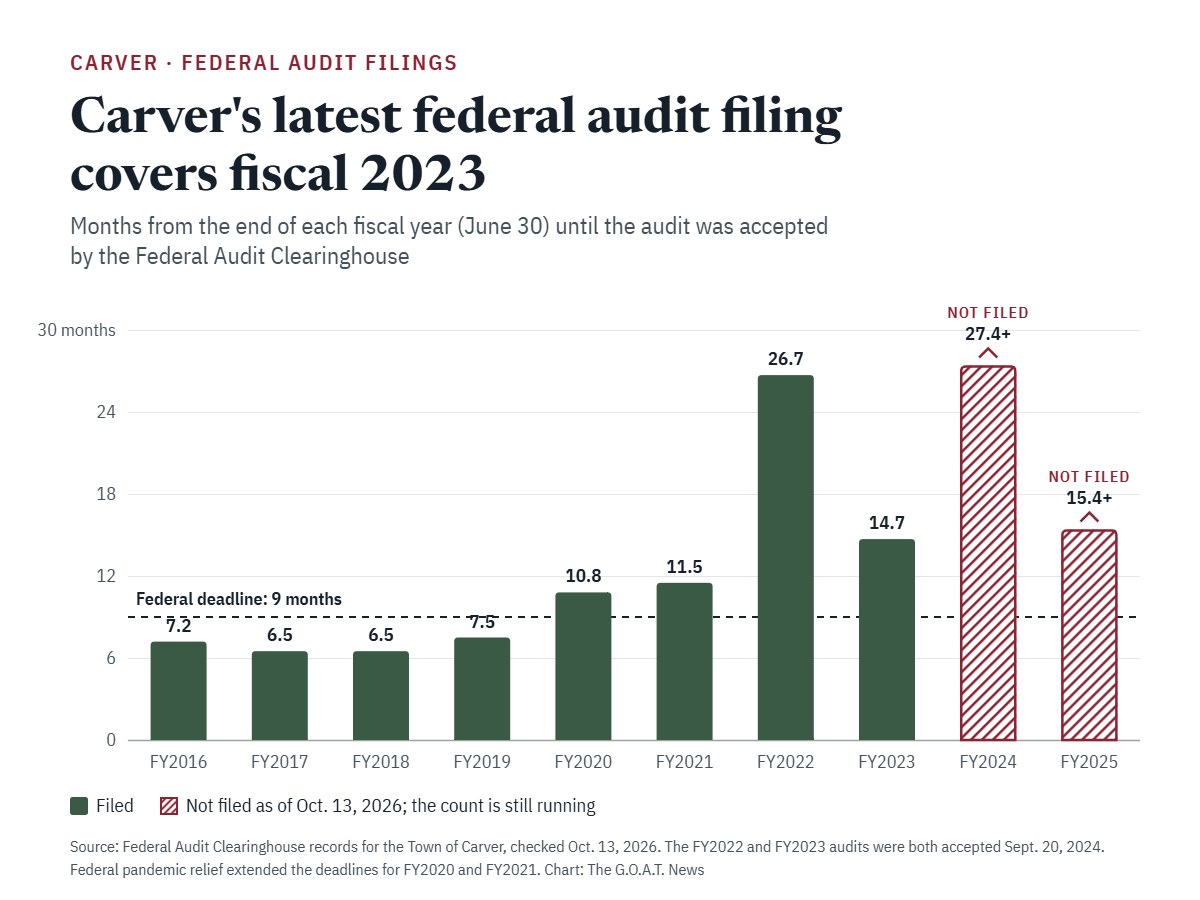
| June 2 | Finance Director reports the town is still waiting on its fiscal 2024 audit. |
| June 30 | Gateway dissolves. |
| Aug. 4 | Union talks continue. Minutes mention “a mitigation fund of around 2M,” never explained since. |
| Oct. 6 | Agenda lists a fiscal 2027 health insurance deficit. Cannon’s letter to employees cites Chapter 32B and puts their share near $1 million. |
| Oct. 20 | Next Select Board meeting. Minutes of Oct. 6 have not been posted. |
| Dec. 1 | Special Town Meeting, 6:30 p.m., Carver Middle High School, including a supplemental appropriation and unpaid bills. |
Questions the public record does not answer
- Is the fiscal 2027 deficit on the Oct. 6 agenda the one Cotter predicted in April, and how large is it?
- What health insurance increase did the fiscal 2027 budget assume, and what has the actual increase been?
- Does Carver maintain a claims trust fund under Chapter 32B, and has any year of it been audited?
- What are Carver’s Schedule Z allocations, and what cash has the solar net metering account actually received?
- Why did the $1,023,920 move from the stabilization fund to the solar account, and who decided?
- What is the “mitigation fund of around 2M,” and does it reduce what employees owe?
- Has the final accounting Clifford described been completed, and did Carver owe the full $4 million?
- Where is the fiscal 2024 audit?
The board meets next on Oct. 20. The Special Town Meeting is Dec. 1.
Barrella serves on the Middleborough Finance Committee and the Town Manager Search Committee. Neither body has a role in Carver’s finances, health insurance or town administration. Middleborough buys employee coverage through the state Group Insurance Commission and was not a Gateway member. Quotations from the April 7 meeting are transcribed from the Area 58 Carver recording. Select Board Chair Mark Townsend has appeared on The G.O.A.T. Podcast, and member Sarah Hewins has been invited.
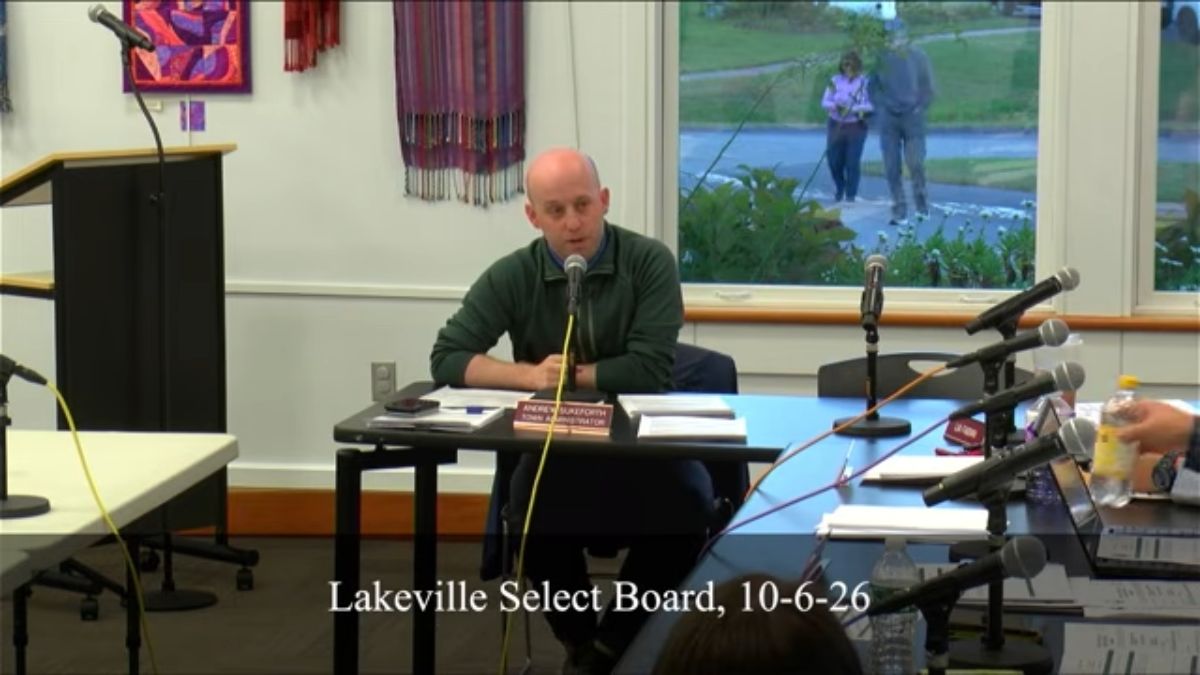
Correction, Oct. 17, 2026: An earlier version of the photo caption misidentified Select Board Chair Mark Townsend as Town Counsel Gregg Corbo.

Leave a Reply