
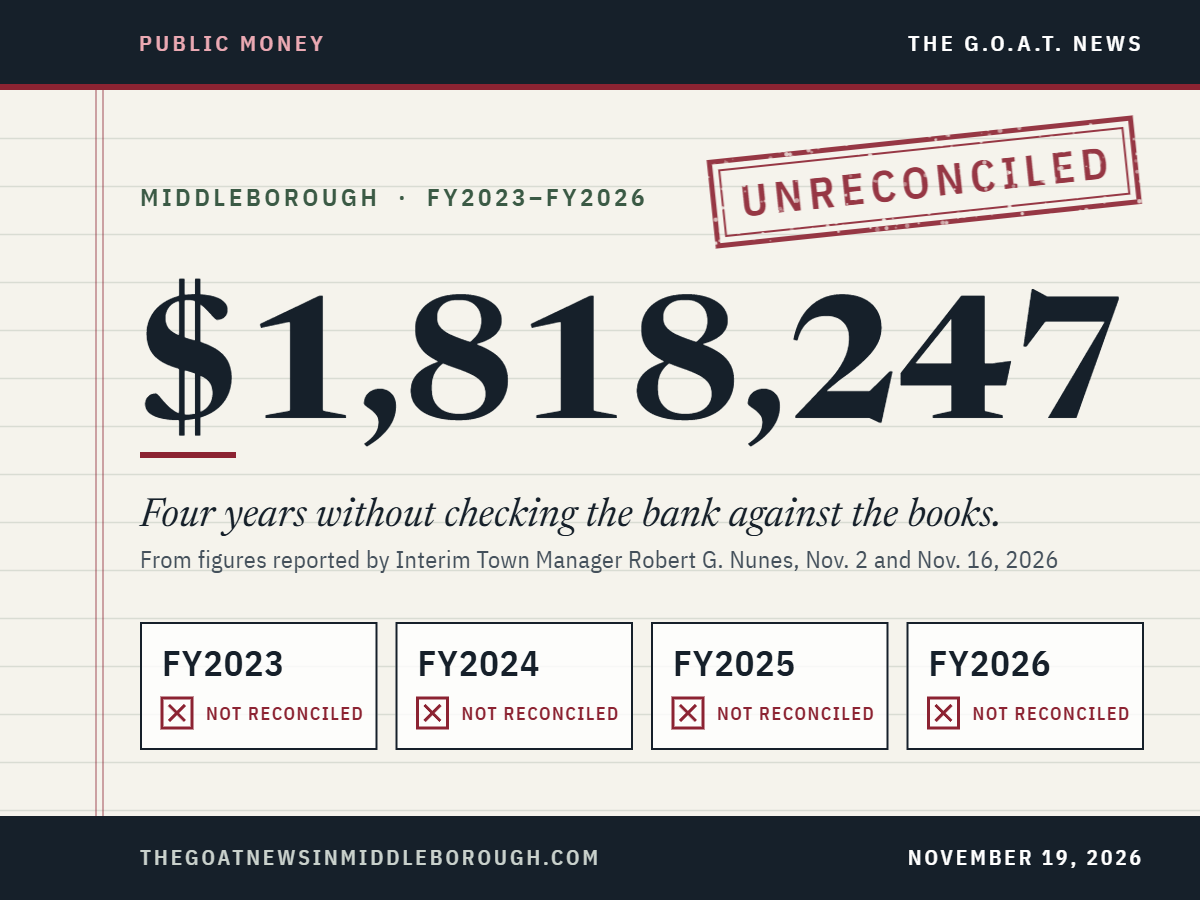
Middleborough’s interim town manager told the Select Board Monday that the town’s cash and its books were off by another $603,083 in fiscal 2026, and the board voted to let him hire a consultant to find out why. Unreconciled cash is one of ten conditions auditors treat as warning signs that the town’s own records now show. None of them is proof of wrongdoing.
Middleborough — The gap between Middleborough’s cash and its own books grew again Monday night, and the Select Board voted to bring in outside help to find out why.
Interim Town Manager Robert G. Nunes told the board that fiscal 2026 closed with an unreconciled cash variance of $603,083. With the $1,215,164.22 he reported for fiscal 2023 through 2025 on Nov. 2, that brings the four-year total to $1,818,247. In all four years, he said, the treasurer’s cash book was never reconciled to the accountant’s ledger or to the bank. “That was not done for four years,” he said. The variance, he added, is “money that could have been free cash.”
The board voted by voice to let him hire a cash consultant through a request for proposals. Town Meeting has set aside $25,000 for the job. Asked whether that would be enough, Nunes said, “I hope.” Reconciling the books will not by itself recover anything, he cautioned. The consultant’s job is to find out why the numbers disagree, and until that work is done the town cannot say whether the bank holds what its books say it should. The four years also include the town’s switch to new financial software, MUNIS, in March 2025, a conversion Nunes on Monday called “extremely stressful and challenging over the last several years.”
Going forward, the new treasurer-collector and assistant town accountant will reconcile the current year back to July 1, so fiscal 2027 should close reconciled. Nunes said he hopes to send the balance sheet to the state this week and the tax recap sheet by the end of November, with a tax rate set in early to mid-December. Tax bills need to go out by the end of the year, and he said the town is confident it will meet that deadline.
The Finance Committee recommended a forensic audit in May, and Select Board Chair Teresa Farley has said publicly that she is “100% for a forensic audit.” The board is waiting for the results of the fiscal 2025 audit before deciding on one. Opening Monday’s meeting, Farley set out the board’s priorities: “Fix the finances. We need to understand how Middleborough reached this point.” The town, she said, must “establish stronger practices and safeguards so we never find ourselves in this position again.”
This report sets out what Middleborough’s own records show, and what auditors look for. It is not an accusation. No Middleborough official has been accused of a crime, and nothing in the records reviewed for this report shows that anyone took money. What the record does show is a town where the safeguards that catch a loss were missing, for years, at the same time. The reconciliation the board approved Monday, and the audit now under way, are the first independent tests of what that cost.
The tripwire was down: unreconciled cash, FY2023–FY2026
A cash variance is a disagreement between records, not a measure of missing money. Common causes include deposits posted to the wrong account or year, checks never cashed, bank fees never entered, posting errors, data that did not carry over between software systems, and transfers recorded on only one side. Money that is actually missing is on the list too. A monthly reconciliation is the routine control built to tell them apart, and Middleborough went four years without one.
Sum of the $1,215,164.22 Interim Town Manager Robert G. Nunes reported Nov. 2 for fiscal 2023 through 2025 and the $603,083 he reported Nov. 16 for fiscal 2026.
The water and sewer funds
Middleborough’s own problems concentrate in its enterprise funds. The town closed fiscal 2026 with shortfalls of $576,041 in water and $105,906 in sanitation and must file a plan with the state to cover them. “It appears that indirect costs were inflated,” Nunes wrote in a Sept. 21 financial update, after the method for charging the water, sewer and sanitation funds changed after 2022. Reported water and wastewater retained earnings fell by $2,033,311 and $998,681 between two editions of the same budget book.
Fiscal 2024 shows the same strain. The water fund’s cash fell $3,139,634 that year, to $4,013,623. The audited statements show $2,385,060 of capital work paid from that cash, along with $1,310,310 in principal and $466,874 in interest, and no borrowing coming in during the year. The town’s year-end filing with the state shows water spending $938,986 more than it took in and sewer $144,098 more. The audited statements for the same year show both funds gaining, water by $1,984,309 and sewer by $1,554,022. The two use different accounting rules, and only a reconciliation can show how much of that gap is method and how much is not. The audited cash flow statement also adds “payments to employees” for water and sewer, $287,135 and $182,694, instead of subtracting them, and reports sewer’s other operating expenses as a negative $241,845. That year’s indirect charges, the ones Nunes says appear to have been inflated, were $925,465 to water and $586,841 to sewer. Nunes has said it may not be possible to re-create the formula behind those charges for that period.
What the annual audit can and cannot do
An annual audit is built to say whether the statements are fairly presented, not to find a thief, and it runs on materiality. Under the standards for government audits, a town’s auditor sets a separate dollar threshold for each part of the statements that gets its own opinion, such as governmental activities, the water and sewer funds and each major fund. It then tests samples against those thresholds rather than every bill, so a payment well below them may never be looked at. Because Middleborough’s audit is a single audit under the federal Government Auditing Standards, its auditor may set lower thresholds than in an ordinary audit. A lower bar is still a bar.
The standards recognize that someone who knows roughly where the lines sit is better placed to stay beneath them, so the fraud standard tells auditors to vary what they test, and when, from year to year. Nothing in Middleborough’s record suggests anyone has tried to work around its audits. The check that sees every payment sits inside town hall. Under state law, the town accountant must examine every bill and payroll before a warrant is drawn, and the treasurer may not pay a bill the accountant disallows.
Separation of duties is the standard defense. The person who creates a record should not approve it, and the person who approves it should not reconcile it. When nobody reconciles at all, the last line of defense is gone.
CBIZ has already told the town to expect weaknesses in its internal controls, including material weaknesses, the most serious kind. Its significant findings so far, Nunes told the Select Board and Finance Committee in September, also include problems with financial reporting, journal entries, debt management and enterprise fund reporting. The firm has reached back to fiscal 2021 and will bill the town an additional $45,000 for the wider scope. A material weakness means there is a reasonable possibility that a material error will not be prevented or caught in time. The full list, and how serious CBIZ rates each item, will not be known until the audit is finished.
The warning signs, counted
Auditing standards group these risk factors into three kinds: incentives to misstate results, opportunities to do it unseen, and attitudes that excuse it. Below are ten recognized conditions and what Middleborough’s own public record shows for each. Every entry is documented.
Ten warning signs, and Middleborough’s record
| Warning sign | What the record shows | |
|---|---|---|
| 1 | Reconciliations not performed | Cash book not reconciled to the ledger or the bank since fiscal 2023. $1,215,164.22 unexplained through fiscal 2025, and a fiscal 2026 variance of $603,083 reported to the Select Board Nov. 16. Nov. 4 |
| 2 | Missing internal controls | “No internal controls,” the interim manager said. “There was no oversight for three years.” Nov. 3 |
| 3 | Incompatible duties in one office | No town accountant for about five months in 2023, through the fiscal 2023 close. For about four of them the town publicly listed its town manager in that role. Oct. 26 |
| 4 | Turnover in key finance roles | Town accountant, assistant town accountant and both treasury posts have turned over or gone vacant since 2022. The finance director left Oct. 21. The public works director gave notice Nov. 4. |
| 5 | Results that change with the report | Fiscal 2025 has been reported four ways, from a $1.3 million positive variance to a $57,668 shortfall, and the surplus version depends on a one-time $2,034,800 land sale. Fiscal 2024’s audited spending exceeds the state filing by $2,804,980 that no published document explains. |
| 6 | Pay tied to reported results | The town manager’s 2024 contract included a $7,500 stipend for maintaining a AA bond rating or better, tying his pay to a rating that rests on the town’s reported finances. Auditors treat compensation tied to financial results as an incentive risk. Aug. 19, 2024 minutes |
| 7 | Spending without a recorded authorization | Two Tahoes, $110,644.10, with no authorizing vote by any of the four bodies that normally approve one. The interim manager said the town manager’s vehicle should not have been charged to public works. Oct. 25 |
| 8 | Records that should exist and don’t | No invoice, meter reading or worksheet for 526 days of water to Carver, and no invoice covering March 2024. Data requested to support a roughly $1 million public works turnback did not amount to an audit trail. No fully executed copy of the Carver water agreement. |
| 9 | Unusual one-time transactions | The November 2025 sale of the town’s future 3M PFAS settlement payments. Free cash appropriated $47,036 beyond the certified amount. Oct. 26 |
| 10 | Limits on independent oversight | Written requests for read-only access to the town’s financial system, MUNIS, made since 2024 and joined by the full Finance Committee in September, have still not been granted. Interim Town Manager Robert G. Nunes promised in September to review the request with the town’s IT department. Starting in 2024, the town manager and finance director stopped attending Finance Committee meetings. Oct. 29 |
Categories follow the risk factors auditors are directed to weigh (incentives, opportunities, attitudes). Each entry is drawn from public records and prior G.O.A.T. News reporting linked in the row.
Not one of those ten is proof that money was taken. A missing invoice can be a clerical failure, and a departure can be a better job. But auditors treat this combination as high risk because it is the combination that lets a loss go unseen.
Two men opened the books
New leadership has opened the town’s books twice this year. The town’s unaudited year-end report for fiscal 2025 showed about $1.3 million to the good. Then Joseph Perkins, newly arrived as interim town manager, told the Select Board the fiscal 2027 budget he inherited was out of balance by about $3.3 million, a gap that grew to about $3.5 million and led to 19 layoffs. Then Nunes arrived and found four years of unreconciled cash. With the books in that state, free cash and retained earnings could not be certified in time for the Nov. 9 Town Meeting, and the town drew on stabilization, its savings account, to pay for warrant articles. Asked what that would do to the bond rating, Nunes said, “That’s not good.”
No annual audit produced any of it. Two men walked into the job, opened what they were handed, and read it differently than the people who wrote it.
What the committee asked for
The Finance Committee’s May 28 recommendation covered fiscal 2022 through 2026 and named ten areas: how the fiscal 2027 budget and its deficit were built; the public works turnback; credit card use, and controls including use after an employee leaves; snow and ice spending; Council on Aging grant reporting; enterprise fund reporting; the PFAS settlement and any conflicts; leave buybacks and payouts; and library maintenance funding. Chair Bob Sullivan said that in his long experience in government he had not seen a budget like the one presented for fiscal 2027, and that finding out what happened was worth the cost. Several of those areas have since turned up in the town’s own disclosures.
The board’s approach follows the usual order. A forensic review is normally scoped from an annual audit’s findings, so a town does not pay one firm to look for questions its regular auditor is already under contract to surface. Nunes has told the board that “a comprehensive review is necessary to determine the underlying causes and establish accurate balances.” When CBIZ finishes the fiscal 2025 audit, its findings, along with the cash consultant’s, should help show the board where a forensic review would need to look.
The record so far
Questions the record does not answer
Why the town’s cash and its books disagree, by $1,818,247 across four fiscal years. The consultant the board authorized Monday is meant to find out.
Whether Middleborough will order a forensic audit. Its chair, Teresa Farley, is 100% for one, and the board is waiting for the results of the fiscal 2025 audit before it decides.
Who held which duties during the fiscal 2023 close, when the town had no accountant, and who signed from fiscal 2023 through fiscal 2026.
What paid for the Tahoes, and what Carver paid for the 556 days of water no invoice covers. The treasury reports would show it.
What supports the public works turnback. The figure was explained to the Select Board, and no audit has tested it.
Why the town changed auditors. Hague, Sahady & Co. had audited Middleborough for years. In June 2025 the former town manager rejected its bid under a requirement that a bidder have audited at least ten Massachusetts municipalities each year over the past three years, and the work went to CBIZ. His letter said the requirement “was not met by the information included in the proposal,” not that the firm lacked the experience. Who wrote the requirement, and whether earlier solicitations had it, the record does not say.
No Middleborough official has been accused of any crime, and nothing in this report should be read to suggest otherwise.
Barrella serves on the Middleborough Finance Committee, which voted 3-2 in May to recommend a forensic audit of fiscal 2022 through 2026, and on the Town Manager Search Committee. He made the forensic audit motion, voted for it and continues to support it, and he wrote the Oct. 13 memo to the town’s auditors cited here. The views expressed are his own and not those of either the Finance Committee or the Town Manager Search Committee. Readers should weigh this report with those interests in view.


Leave a Reply