
Middleborough · Town Finances
Town Meeting will be asked to cover $681,947 in FY26 shortfalls in the water and trash funds. An audit with serious findings, a consultant review and a recalculation of what the utilities owe the town are all still under way.

MIDDLEBOROUGH — Middleborough’s water and trash funds ended the last fiscal year short, and voters will be asked to cover the gap. How the funds got there, and whether the numbers behind them hold up, will not be known until several outside reviews are finished.
The draft Fall Special Town Meeting warrant, which the Select Board and Finance Committee review Monday night, asks voters to move $576,041 from the water fund’s savings to cover its fiscal 2026 shortfall (Article 3) and $105,906 from the trash fund’s savings to cover its own (Article 4). Town Meeting is scheduled for Nov. 9 at 7 p.m. in the Middleborough High School auditorium.
Water, sewer and trash run as enterprise funds. Ratepayers’ bills are supposed to cover their costs, and each fund keeps its own savings, called retained earnings. When a fund loses money, state law says the loss “shall be included in the succeeding fiscal year’s budget.” Covering it from the fund’s own savings keeps it off the tax rate.
Shortfalls like these happen in other towns. What sets Middleborough apart is how much else is unsettled at the same time.
A long list of open questions
The town’s auditor, CBIZ, has found material weaknesses in Middleborough’s financial controls and now wants records going back to fiscal 2021, The G.O.A.T. News reported last week. A material weakness is the most serious control finding an auditor can issue.
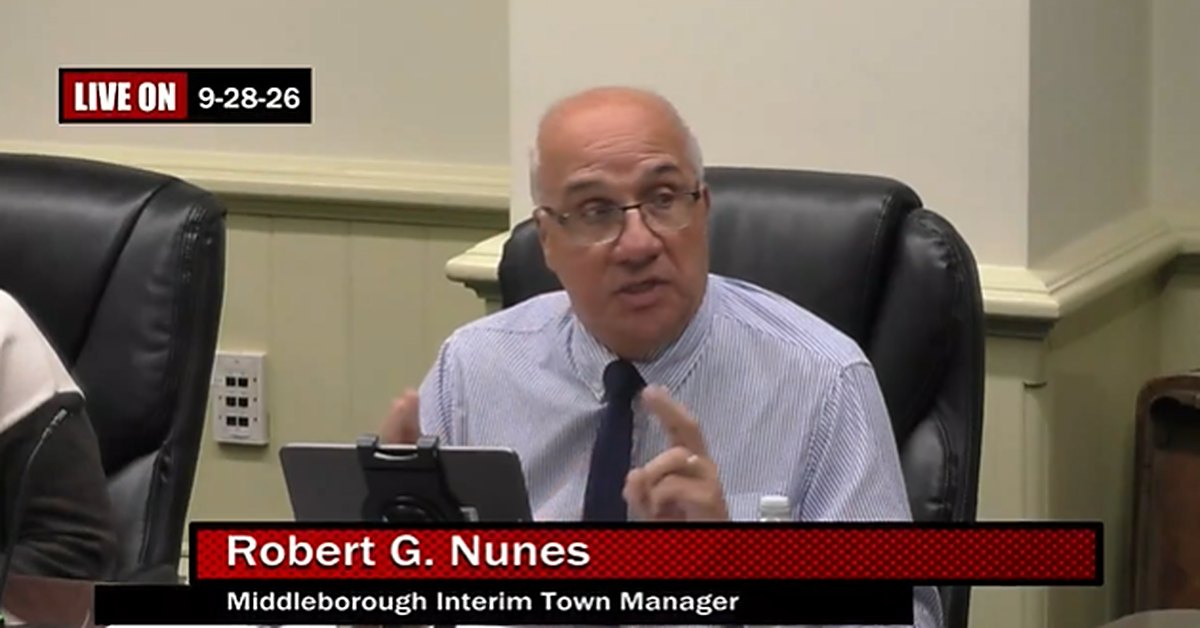
At the Sept. 21 joint meeting, Interim Town Manager Robert Nunes told the boards that the fiscal 2025 audit is behind. “The audit is late, but more importantly, the findings will be serious and a lot is at stake with this audit,” he said. He recommended hiring an outside consultant to address the findings, saying finance staff are already working at full capacity, according to the meeting minutes.
Nunes also said the indirect costs charged to the water, sewer and trash funds, which cover benefits, administration and other shared expenses, need to be “reviewed and recalculated.” He recommended an outside consultant for that work as well. The minutes record that he said the town must submit a plan to the Department of Revenue on how the fiscal 2026 enterprise deficits will be resolved, and that the water rate increase that took effect Jan. 1, 2024, will be reviewed to make sure rates cover all costs, including debt.
The warrant shows how large those indirect charges can move. Article 6 would cut the fiscal 2027 indirect charge to water from $1,611,355 to $1,296,636. Article 7 would cut the wastewater charge from $1,865,206 to $883,292. Together that is $1,296,633 the general fund had counted on and will now have to make up elsewhere. A year earlier, the town’s fiscal 2026 budget book listed water’s indirect cost at $3,444,118.
By the numbers
| Item | Amount |
|---|---|
| FY26 water shortfall (Art. 3) | $576,041 |
| FY26 trash shortfall (Art. 4) | $105,906 |
| FY27 indirect charges cut (Arts. 6 and 7) | $1,296,633 |
| Added audit cost | $45,000 |
| Projected added water debt, next 5–10 years | up to $110 million |
Sources: Fall 2026 STM warrant; Sept. 21, 2026 Select Board minutes; G.O.A.T. News, Sept. 29, 2026.
Two ways of counting
The state and the town measure these funds differently, and the two pictures do not match.
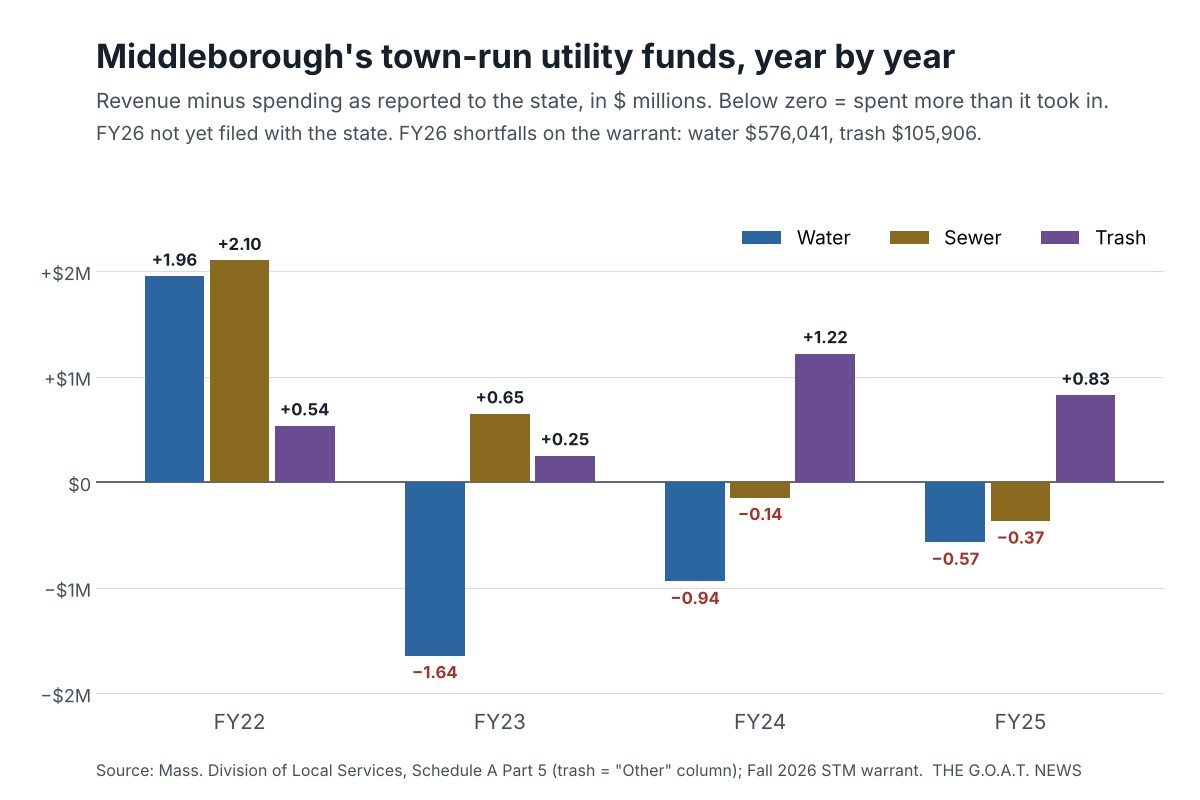
In the yearly reports the town files with the state’s Division of Local Services, the water fund spent more than it took in for three straight years: by $1.64 million in fiscal 2023, $939,000 in fiscal 2024 and $568,000 in fiscal 2025. Sewer came up short in fiscal 2024 and 2025. Trash stayed above the line every year.
The town’s own reports show positive savings in all three funds through fiscal 2024, the latest year published. The water fund carried about $5.37 million, according to the fiscal 2026 budget book. Nunes told the boards on Sept. 21 that the Finance Director confirmed the water fund did not end fiscal 2024 or 2025 in deficit.
Both can be true. A fund can spend more than it collects in a year and still hold money in savings, as long as it is drawing down reserves that Town Meeting voted to use. But in some years the two sources move in opposite directions. The state’s report shows a water surplus of $1.96 million in fiscal 2022, while the water savings reported in the town’s 2022 Annual Town Report fell by $3.37 million. The town has not published a year-by-year reconciliation of the two.
What isn’t known yet
- The results of the fiscal 2025 audit and how far back its findings reach
- What the outside consultant finds on indirect costs and enterprise charges
- Fiscal 2025 retained earnings for water, sewer and trash
- Certified free cash, which Nunes said he does not expect to be significant
- Whether water and sewer rates cover costs, including future debt
Why it matters now
Nunes told the boards that projected water enterprise debt over the next five to 10 years may total an additional $110 million, not counting trucks, tanks and a new water tank. Asked about the risk to the town’s bond rating by this reporter, who serves on the Finance Committee, Nunes said rating agencies have been strict lately and several neighboring communities have been downgraded. A lower rating means higher interest on that borrowing.
The shortfalls on the November warrant are the ones known today. Until the auditor, the consultant and the indirect-cost review report back, nobody can say whether they are the whole story. Voters will be asked to act before those answers are in.
Barrella serves on the Middleborough Finance Committee, which makes recommendations to Town Meeting on these articles, and on the Town Manager Search Committee, which has no role in them.
Leave a Reply