
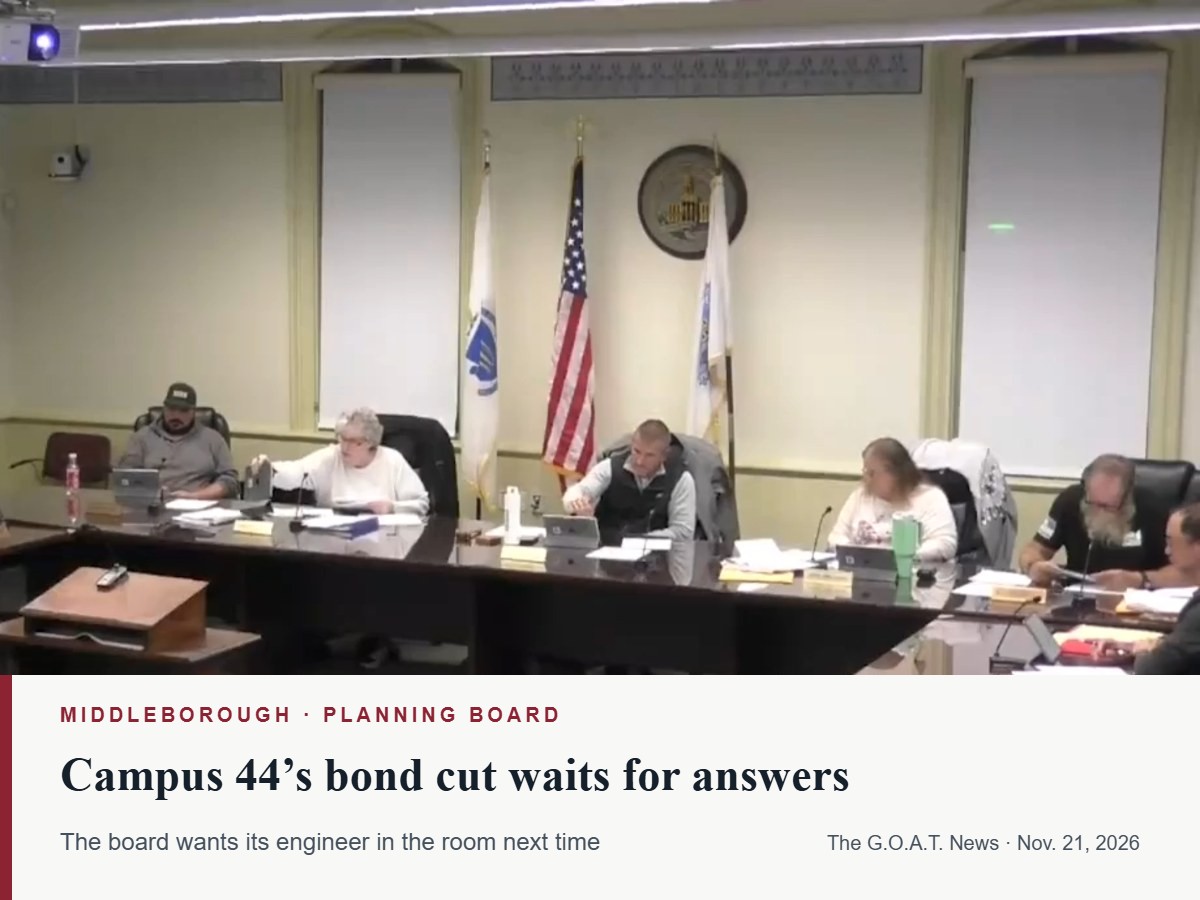
Middleborough · Planning Board
Members could not square a request to cut the security on the industrial park’s first phase with a letter of credit that also covers a phase not yet built. Later that night, the board sent the same engineering firm a letter about a potential conflict of interest.
John Barrella – The G.O.A.T. News · Nov. 21, 2026

MIDDLEBOROUGH — The Planning Board on Tuesday put off a request to shrink the security behind the Campus 44 industrial park, after members said they could not tell from the paperwork how much would be left to cover a phase of the project that has not been built.
The board met Nov. 17 at 6:30 p.m. in the Select Board’s meeting room at Town Hall, according to its amended agenda. The full meeting is on MCCAM’s on-demand channel. Minutes have not been posted yet and would normally come up for approval at the board’s next meeting. The account below comes from the recording and the town’s posted documents.
The decision on a bond reduction belongs to the Planning Board alone. Members voted to take the request up again at their next meeting, with the town’s construction-review engineer in the room to explain it.
A request for Phase A
Town Planner Leeann Bradley presented the item. The developer had asked to reduce the security on Phase A of Campus 44, the industrial park off Canopy and Timber drives, she said. PMP Consulting, the firm that reviews construction for the board, had sent a review letter and a new bond estimate approving the request.
The security is a letter of credit, Bradley said. If the board approved the cut, the developer would ask the bank that issued it to lower the amount, and the town treasurer would keep the revised letter on file.
Board member Tracie Craig-McGee pointed out that PMP’s letter said the security covered phases A and D together. Bradley said the project has been bonded in pieces from the start, with one bond for A and D, another for C and another for B. She said she had gone back through the file because Joe Mandile, the former town planner, had handled it.
PMP has done a complete estimate, she said. “They know what we can release and what we need to hold.” Craig-McGee asked why the board would reduce a bond that still covers Phase D when Phase D has not been built, and whether the developer would have to come back with new security before starting it.
Vice Chairperson Nancy Kefalis read from the second page of PMP’s revised summary. It said the Phase D bond had been removed from the revision “pending the issuance of the necessary permits from MassDOT.” Members asked what that meant. No one at the table could say.
Bradley said the arrangement was unlike any subdivision she had handled. Projects are often built in phases, she said, but usually each phase has its own bond. “We should have had PMP here,” she said. “I said no, I don’t think we need them, but I think we should have.” She added that the request was “more intricate than I had originally thought.”
Craig-McGee moved to put the request on the board’s next agenda and to have PMP attend. Frawley seconded, and the motion passed by voice vote.
What a bond reduction is, and why it matters
A subdivision bond is the money a developer puts up so the town can finish the roads and utilities if the developer does not. Under the state’s Subdivision Control Law, Chapter 41, Section 81U, a planning board must require that security before it endorses a subdivision plan. The developer chooses the form: a bond, a deposit of money or securities, a covenant recorded with the deed, or an agreement with a lender. The amount has to bear a reasonable relationship to what it would cost to finish the work.
The law also says the amount must “from time to time be reduced” so that it keeps matching the cost of the work still to be done. That is what a reduction is. As roads, drainage and utilities go in, the developer asks for some of the money back, the board’s engineer inspects and prices what is left, and the board votes.

The stakes run both ways. A bond that stays too high ties up a developer’s credit for work that is finished. A bond cut too far leaves the town short if the developer walks away, and taxpayers or the people who bought into the project end up paying to finish it. Once a developer reports the work complete by registered mail, the statute gives the board 45 days to list what is missing. If it does not, the bond ends by operation of law.
In Middleborough the process usually runs through PMP. In September, PMP’s Patrick Carrara wrote that the Morton Estates subdivision was complete with nothing outstanding, and the board cut that bond to $5,000 on a 5-0 vote, according to the Sept. 15 minutes. At an April working session, members suggested charging developers $250 to consider a reduction request, the Apr. 28 minutes show.
Campus 44 raises the stakes because its roads are meant to stay private. When the board approved another commercial subdivision in August, the developer’s attorney and Bradley said that road would remain permanently private, in line with the town’s approach at Campus 44, The G.O.A.T. reported. A town that will never own a road has one main way to make sure it gets built to the approved plan, and that is the security.
The park already carries large sums. On Jan. 20, Carrara told the board the security for Phase C came to $2,322,600.36, and the board voted unanimously to release Lots 3 and 4 once it was posted, according to the Jan. 20 minutes. REXA opened its headquarters in the park this summer, and Indus is headed there, The G.O.A.T. has reported.
Campus 44
The security, phase by phase
Sources: the Nov. 17 recording and the board’s Jan. 20 minutes. The Phase A and D amounts were not read aloud at the meeting.
The public record so far
Campus 44 before the Planning Board
Sources: Planning Board minutes, the Nov. 17 recording and prior G.O.A.T. coverage.
The firm behind the estimate
Later in the meeting, Bradley raised what the agenda called a potential conflict of interest involving the board’s construction-review consultant. PMP does engineering reviews on many of the subdivisions that come before the board, she said, and Pat Carrara of PMP does construction observation on them.
The firm had also submitted two plans for accessory dwelling units to her office for review and approval, Bradley said. She denied one because it placed the unit in a front yard, which the town does not allow. “They’re working for us and then they’re submitting, and I have to review it and approve it or deny it,” she said. She said she talked to Carrara about it and he was not happy, and that she turned the matter over to Bob Whalen, the town’s building commissioner.
Bradley drafted a letter to PMP for Chairperson Allin Frawley to sign. A member predicted the board would hear back, saying PMP has “always been more than reasonable.” Asked whether the board had a backup if PMP said no, the answer from the table was, “We’ll have to find one.” The board voted unanimously to sign the letter and send it. No one at the meeting accused PMP of wrongdoing, and the discussion did not involve Campus 44. The bills on the night’s agenda included a $780 PMP invoice for Campus 44, according to the agenda. Developers reimburse the town for that review.
The accounts that pay the engineer
Bradley asked for a $5,000 minimum balance in every construction-observation and engineering-review account, the developer-funded accounts that pay consultants like PMP. Accounts holding $1,500 have been receiving $2,000 bills, she said, and the town has paid them, run a negative balance and then asked the developer for more. “I’m not comfortable with that,” she said. “Just with everything that’s going on with finances, I want to make sure that we have the money before we pay a bill.” The board approved the minimum by voice vote.
Voting record
How the board voted
Nov. 17, 2026
Hold the Campus 44 Phase A bond reduction for the next meeting and have PMP attend
Passed by voice vote. Motion: Tracie Craig-McGee. Second: Chairperson Allin Frawley.
Nov. 17, 2026
Require a $5,000 minimum balance in construction-observation and engineering-review accounts
Passed by voice vote.
Nov. 17, 2026
Have the chair sign and send Bradley’s letter to PMP on a potential conflict of interest
Passed unanimously.
Sept. 15, 2026
Reduce the Morton Estates bond to $5,000
Passed 5–0. Motion: Anders Martenson IV. Second: Craig-McGee.
Feb. 3, 2026
Grant the Campus 44 Lot 4 special permit, 400 Canopy Drive
Passed unanimously. Motion: Martenson. Second: Nancy Kefalis.
Jan. 20, 2026
Release Campus 44 Lots 3 and 4 once the $2,322,600.36 Phase C security is posted
Passed unanimously. Motion: Martenson. Second: William Garceau. Craig-McGee was absent.
Nov. 17 votes are from the MCCAM recording; members voted by voice. Earlier votes are from the board’s Jan. 20, Feb. 3 and Sept. 15 minutes.
Barrella owns and publishes The G.O.A.T. News. He serves on the Middleborough Finance Committee and the Middleborough Town Manager Search Committee. Neither body has a role in the Planning Board decisions in this story.


Leave a Reply