
Voters shot down four funding amendments and a $1.3 million stabilization transfer, leaving the district’s budget standoff for state regulators to eventually resolve
By John Barrella
July 29, 2026
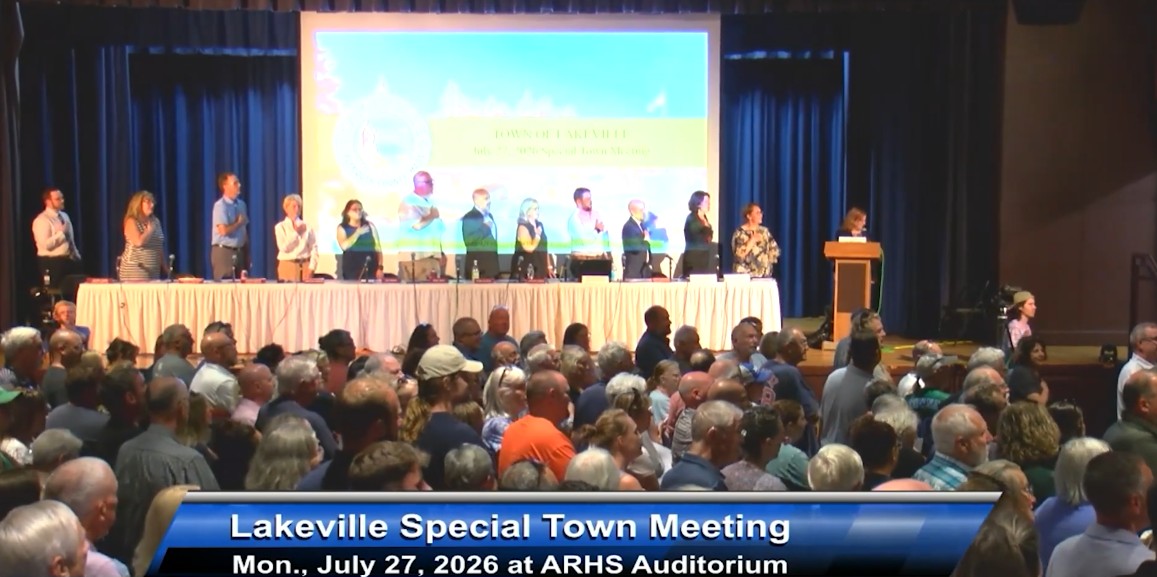
LAKEVILLE — For the second time this year, town meeting voters here rejected a plan to plug a widening hole in the Freetown-Lakeville Regional School District’s budget, capping a two-hour Special Town Meeting Monday night that swung between dense fiscal minutiae and raw audience frustration before ending almost exactly where it began.
The warrant’s single substantive article asked residents to transfer $1,353,284 from the town’s general stabilization fund to cover the gap between the $350,000 school increase voters approved at June’s Annual Town Meeting and the full $1.7 million assessment the regional school committee was demanding. After nearly two hours of amendments, procedural votes, and dueling counts from the main auditorium and an overflow crowd in the cafeteria, the article failed on a counted vote of 247 to 154 — shy of the two-thirds threshold required.
It was the meeting’s only real drama, but it took a long road to get there.
Four tries, four defeats
Resident Bryan Enloe of Cedar Pond Road spent much of the meeting at the microphone, offering a string of amendments meant to spare the stabilization fund by patching the school assessment together from smaller, alternative sources instead.

His first amendment sought to redirect $275,000 in anticipated “Cherry Sheet” state education aid — a Chapter 40R smart-growth reimbursement tied to Lakeville’s housing near the commuter rail station. Town Administrator Andrew Sukeforth and Finance Director Mike Ellis pushed back hard, noting the town had received only a fraction of similar promised reimbursements in each of the past two years. Enloe, defending the source, told the meeting the number he’d landed on “is the amount that was left over after the $432,000” already committed elsewhere. Voters weren’t convinced: the amendment failed, 165 to 252.

A second amendment would have pulled $150,000 from the town’s FY27 reserve fund — money set aside, officials explained, for genuine emergencies like storm damage, not routine budget gaps. It failed, 163 to 253.
A third proposed shifting $86,000 from capital stabilization, prompting a sharp warning from resident Lacy Marshall, who cited the town’s bond consultant, Hilltop Securities, and Standard & Poor’s ratings history: Lakeville’s reserve ratio has slid from 27.1 percent in 2023 to 18.6 percent last year, and further draws could push the town’s credit rating down and add hundreds of thousands of dollars a year in borrowing costs. That amendment failed too, 165 to 251.
Enloe’s fourth attempt tried to fold his three funding ideas together, trimming the town’s stabilization draw down to $500,000 and leaving the rest for the school committee to absorb through its own reserve accounts. But the arithmetic didn’t hold up under scrutiny — Select Board Chair Lorraine Carboni stopped to double-check the figures with the finance director mid-meeting — and after a teller reported confusion among voters about what exactly was on the table, Enloe withdrew the amendment himself rather than force a vote.
With no amendments left standing, the meeting returned to the original $1,353,284 request. It failed by nearly two to one.
A room running out of patience
If the amendments were about spreadsheets, the debate around them was about something else — a town’s exhaustion with a budget fight now in its third round this year.
Sukeforth, presenting the numbers, was blunt about what another year of stabilization draws would mean, warning fiscal 2028 would be “very, very bad” without a structural fix. Both the Select Board and Finance Committee, despite bringing the article forward themselves, formally recommended against it.

From the floor, the frustration cut in different directions. Regional School Committee member Katherine Trost, speaking, she said, as a resident rather than in her official capacity, argued the fault lay as much with town hall as with the schools, accusing Lakeville’s leadership of never building the tax base needed to ease pressure on homeowners. “We are on a trajectory to hit rock bottom,” she told the meeting, drawing applause.
Resident Brynna Donahue pressed for accountability of a different kind, noting that a school financial audit both towns’ select boards had unanimously ordered back in 2023 still had no defined scope three years later. She invoked disputed literacy statistics and the district’s Chromebook policy before the moderator repeatedly ruled her questions outside the article’s scope.
Perhaps the sharpest moment came from Steven Place, an 86-year-old Clark Shores resident recovering from a broken leg and hip replacement, who asked through a microphone carried to his seat why the district needed more money at all. Told the funds were for operations, not new construction, he didn’t hold back, telling the meeting the increase amounted to little more than “plain unadulterated greed” — a line that drew loud applause of its own.
By the meeting’s final stretch, calls to “call the question” and end debate came rapid-fire, with one resident cutting through the room’s fatigue directly: “Let’s get the heck out of here. It’s not going to pass. Let’s move on.”
What’s left
With the funding article defeated, a companion citizen’s petition proposing to rebuild the entire fiscal 2027 operating budget from multiple funding sources — along with two related petition articles — never got a debate at all. Its sponsor, watching the vote unfold, asked to withdraw all three rather than force the issue further. The motion to postpone them indefinitely passed on a voice vote, and the meeting dissolved minutes later.
The fight now returns to the regional school committee, which can either accept Lakeville’s reduced number or convene up to two joint town meetings with Freetown to try to resolve the assessment jointly. If both towns remain deadlocked after that, the state Department of Elementary and Secondary Education is positioned to step in on Dec. 1 and set the budget itself.
As the crowd filed out past 8 p.m., one resident summed up the night more bluntly than any official had. “Waste of time,” he muttered, shaking his head. “I swear to God. I come to these things for a reason.”



Leave a Reply