
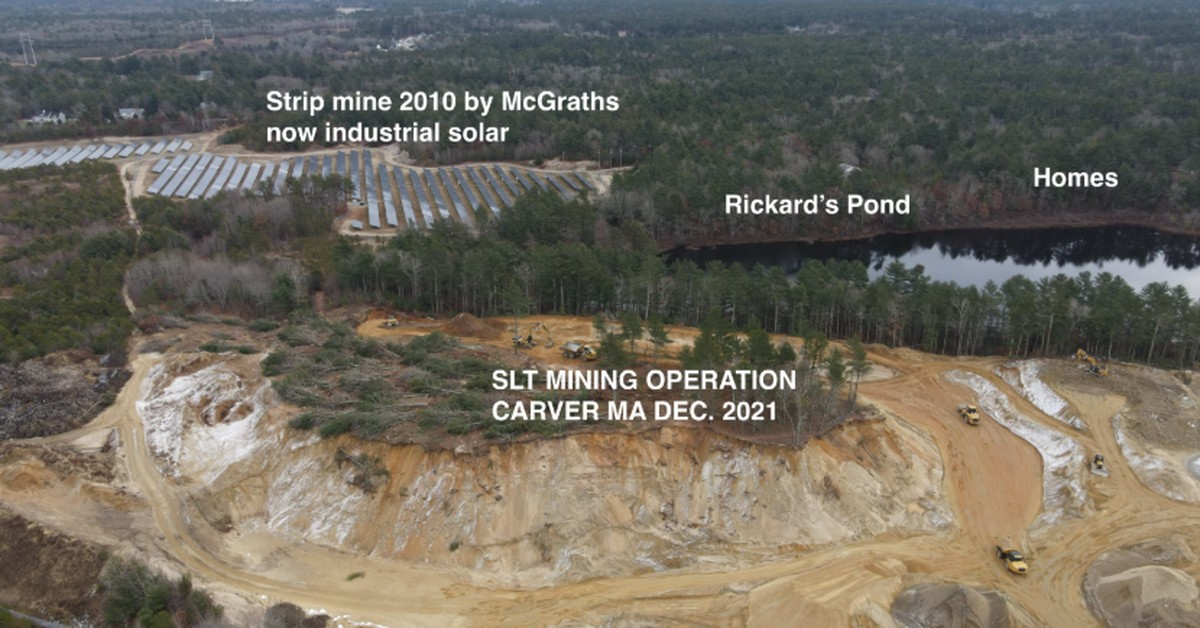
Millions of cubic yards of sand have left Carver under the cover of farming permits. A Boston environmental group now says it’s ready to sue — the latest turn in a fight that has divided the town for years.
By John Barrella
August 8, 2026
CARVER — Drive down Federal Road or Tremont Street on any weekday and the evidence is hard to miss: convoys of dump trucks, tree lines abruptly giving way to bare sand, and a fine dust that residents say settles on cars, porches and windowsills long before it settles any argument about who’s responsible for it.
For more than two decades, this town of roughly 12,000 people has sat at the center of a quiet but increasingly contentious industry — the mining and sale of sand and gravel, much of it excavated under permits issued for cranberry farming. Critics say that “agricultural” farming has become a loophole large enough to drive a fleet of trucks through. The companies doing the digging say they’re simply preparing land for bogs that take years, sometimes decades, to materialize.
That long-simmering dispute escalated last month. The Conservation Law Foundation, a Boston-based environmental group, notified A.D. Makepeace Company — the state’s largest cranberry grower and Carver’s dominant private landowner — that it intends to sue under the federal Clean Water Act. The group alleges the company has spent more than a decade illegally strip-mining sand from bog sites in Carver and Plymouth, filling and damaging protected wetlands without the federal permits the law requires.

A Makepeace spokeswoman rejected the accusation, telling the Plymouth Independent that criticism of the cranberry industry along these lines had persisted for years without any court, state agency or local board ever finding wrongdoing.
A bylaw built for farming, used for industry
At the center of the dispute is Carver’s Earth Removal Bylaw, enforced by the town’s seven-member Earth Removal Committee. The bylaw is meant to regulate the reshaping of land when earth is dug up and sold — but it treats sand removal tied to agriculture differently than removal for straightforward commercial mining, and opponents say that distinction has been exploited for years.
According to research compiled by the Community Land and Water Coalition, a Plymouth-based advocacy group that has tracked the issue since the early 2020s, the ERC has issued permits for more than 3.3 million cubic yards of sand and gravel removal since 2003, much of it justified as necessary groundwork for future cranberry bogs that in several cases were never built. In February 2024, the committee approved two new permits — to Makepeace and to EJ Pontiff Cranberries — covering roughly 3 million additional cubic yards with a combined market value the coalition estimated at $30 million to $40 million.

Some of that mining sits atop the Plymouth-Carver Sole Source Aquifer, the federally protected groundwater supply that the region depends on for drinking water. Removing the sand layer that normally filters surface water before it reaches the aquifer is the central environmental concern, according to Scott Horsely, a hydrologist who has been retained by towns and resident groups examining the issue.

Neighbors, a lawsuit and a decade-old promise
Jen Bogart has lived across from one Carver mining site since 2011, watching the excavation outlast every timeline the company gave her. “We just want the truth. Just be honest,” she told GBH News last year, describing years of shifting promises about when the digging would end and the bog would finally go in.
Frustration like Bogart’s has already produced litigation. Ten Carver residents sued years ago under the state’s citizen-suit law alleging environmental damage at one long-active site. Separately, Meg Sheehan, the environmental lawyer who leads the Community Land and Water Coalition, filed a $20 million federal civil rights suit in 2024 accusing town officials and mining-linked businesses of harassing her in retaliation for her advocacy — a case that remains pending. Court records cited by the Plymouth Independent show a Makepeace in-house attorney was behind an anonymous Facebook page that mocked Sheehan personally; the company has defended the posts as a response to her campaign against its permits.
Critics have also raised conflict-of-interest questions about the committee that oversees the permits. Reporting by the Plymouth County Observer has noted that some ERC members have past or present business ties to excavation, trucking or cranberry operations regulated by the committee — arrangements state law does not clearly prohibit given how the seven-member board is structured, with seats reserved for the cranberry and construction industries alongside town appointees.
The industry’s defense
Not everyone in the cranberry business accepts the framing that mining has swallowed farming. Brian Wick, executive director of the Cape Cod Cranberry Growers Association, has said operations on the scale of Makepeace’s are, in his words, in the minority by far. He argues responsibility for keeping sand removal tied to legitimate agriculture falls to growers and town officials alike, and that a struggling cranberry market makes the underlying farming operations more important, not less.
Makepeace itself did not respond to GBH’s request for comment on that story, though the company has consistently maintained in litigation that its work is lawful and that opponents are really trying to block economic development in the region.
What comes next
The town has not been entirely passive. Carver’s Conservation Commission issued a cease-and-desist order in early January against Makepeace over wetlands filling at a Federal Road site, and the Earth Removal Committee has continued to field complaints and permit requests at its monthly meetings this year. A bill pending on Beacon Hill would give the state a more direct role in regulating sand mining’s effect on drinking water, something local advocates have pushed for after years of feeling that enforcement was left almost entirely to the town.
The Conservation Law Foundation’s Clean Water Act claim, meanwhile, is still in its early stage — the group was required to give Makepeace 60 days’ notice before filing suit in federal court, a clock that starts ticking toward a filing this summer. If the case goes forward, the foundation has said penalties could run into tens of thousands of dollars per violation, for violations reaching back a decade or more.
For residents like Bogart, the legal maneuvering is almost beside the point. What she has wanted, she’s said, is simpler than a verdict: an honest answer about whether the bog behind her house is ever coming, or whether the sand pit is what her neighborhood is now.
Do you have information about earth removal permitting in Carver or neighboring towns? The Goat News wants to hear from you.



Leave a Reply