
By John Barrella
CARVER — When the town’s Earth Removal Committee gavels in Tuesday afternoon for a routine agenda — a requested delay on one sand-and-gravel matter, a look back at a site visit on another — it will do so as a body whose own composition has drawn years of conflict-of-interest complaints and, more recently, brushed up against a federal lawsuit.
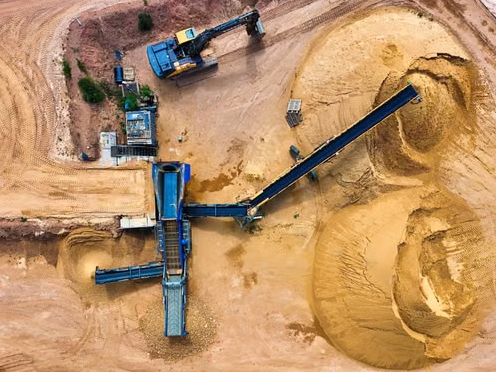
The committee, which the town bylaw sets at seven members, meets at 3 p.m. in Room 4 of Town Hall and is the local gatekeeper for one of Southeastern Massachusetts’ most lucrative and contested industries: the removal of sand and gravel from the sandy soils of the Plymouth-Carver region, often stripped from land as cranberry growers reshape or expand their bogs.
Critics have long argued that the mining is dressed up as agriculture to sidestep permits, draining an aquifer that supplies drinking water to more than 100,000 people. In August, the Conservation Law Foundation sued one of the region’s largest operators, A.D. Makepeace, in federal court, alleging years of unlawful wetlands destruction from sand mining at sites including two in Carver.
https://www.clf.org/newsroom/ma-cranberry-grower-and-sand-miner-damaging-wetlands-and-waterways

By the town’s own bylaw, the committee that regulates that activity is built, in part, from the industry it oversees. The seven-member panel reserves seats for nominees of the cranberry growers and one seat expressly for “a member of the trucking industry.” In practice, that has meant a committee led and staffed for years by people who grow cranberries, mine sand, or haul it.
Tuesday’s agenda
The immediate business on Tuesday is modest. The committee is scheduled to take up a continued public hearing for applicant Derek Maksy, tied to a parcel listed as 0 Wareham Street (Map 126, Lot 13-0); according to the agenda, Maksy is asking that the matter be pushed to the committee’s October meeting. Members are also set to review an Aug. 29 site visit connected to Permit 24-01 at 104 Tremont Street, hear a report from the committee’s agent, and handle routine bills.

The agenda also notes, as Carver committee agendas do, that the public-access station Area 58 will record the meeting and asks any other person recording to state their name for the record.
A committee of insiders
The committee’s chair, Scott Hannula, is himself a cranberry grower and longtime figure in the sand and trucking business; public filings identify him as an officer of two family cranberry companies that own bogs in Carver, and his firms have held earth-removal permits from the very committee he now leads. He was named chair in 2023 as an “industry representative.” His predecessor as chair, who led the committee for roughly three decades until 2022, ran a cranberry company that mined sand from its own land during his tenure.
Among those who have served on the committee is Alan Germain, who owns and operates Alan Germain Trucking. Germain’s company hauls sand and gravel for SLT Construction Corporation, a Carver-based firm that excavates and sells silica sand from mining sites in town — the same category of operation the Earth Removal Committee is charged with regulating. Germain was brought onto the committee in 2023 to fill its trucking-industry seat.
Germain also holds or has held some of the most prominent civic posts in Carver: he was elected town moderator in April 2024, has served as chair of the Finance Committee, and has been chair and vice chair of the Conservation Commission — another body that reviews sand-and-gravel projects for their impact on wetlands.
None of these arrangements is necessarily unlawful. Massachusetts municipalities frequently seat industry members on technical boards, and the state’s conflict-of-interest law, G.L. c. 268A, generally turns not on membership itself but on whether an official participates in specific matters affecting their own financial interests, and whether they properly disclose and step aside. Committee minutes show members do at times recuse themselves from site visits involving companies they are connected to.
Ethics complaints and a federal suit
The industry makeup of the committee has drawn formal challenges. The Community Land & Water Coalition, an environmental group co-founded by attorney Margaret “Meg” Sheehan, has for years pressed the town over what it describes as conflicts of interest on the committee.
Germain is also one of several defendants in a federal civil-rights and defamation lawsuit Sheehan filed in September 2024 in U.S. District Court in Boston, which names the towns of Carver and Plymouth, several local officials, and two sand-mining companies. The suit alleges, broadly, that the defendants worked to silence Sheehan’s advocacy against sand mining in the region. In a May 2025 ruling, U.S. District Judge Allison Burroughs dismissed a number of Sheehan’s claims but allowed others to proceed, including claims against Germain; in a March 2026 ruling, the judge denied an effort by two of the corporate defendants to dismiss additional claims under the state’s anti-SLAPP law. The defendants have denied Sheehan’s allegations, and the case remains pending.
Residents have separately said that investigators from the Massachusetts Office of the Inspector General visited Carver Town Hall in March 2023 seeking records related to earth-removal permitting. The Inspector General’s office, asked previously about an inquiry, has declined to comment.
The stakes
Behind the procedural agenda items lies a resource question that has animated Carver politics for years. By one accounting presented to the committee, more than 30 million cubic yards of earth have been removed from Carver over the past two decades, with more than 1,000 acres disturbed, deforested, or stripped — activity that residents in the Great Meadow area of South Carver have linked to private wells running dry.
The committee has generally declined to take dramatic enforcement action, and its defenders note that it collects per-cubic-yard fees that fund road repair and staff, and that it operates within a bylaw and a state regulatory framework that treat much bog-related excavation as agricultural.
Reporting note: This article is based on the Earth Removal Committee’s posted agenda, Town of Carver records and meeting minutes, federal court filings in Sheehan v. Town of Carver et al. (D. Mass. No. 24-cv-12347), Massachusetts Department of Transportation carrier records, and a Conservation Law Foundation announcement of its Clean Water Act suit against A.D. Makepeace. The lawsuit claims described here are unproven and the defendants deny them. Committee membership rotates; readers seeking a member’s current status should consult the town’s appointed-committee listings.


Leave a Reply